


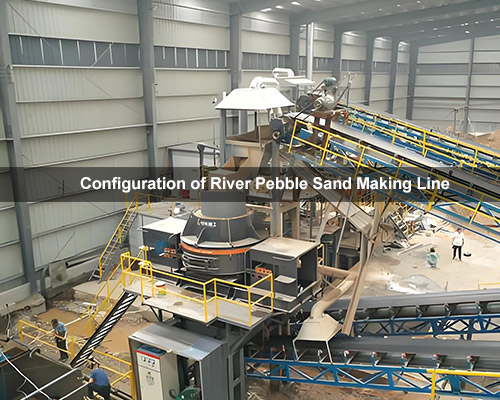
Configuration of River Pebble Sand Making Line
River pebbles are an abundant and high-quality resource for construction aggregates. However, their high hardness and high silicon content pose a significant challenge for investors. If the Configuration of River Pebble Sand Making Line is not scientifically designed, the rapid wear of liners and hammers can drain your profits quickly. Many inexperienced operators suffer from high Operating Expenses (OPEX) simply because they chose the wrong equipment sequence.
At Liming Heavy Industry, we have successfully installed hundreds of river pebble processing plants globally. Our solution focuses on one core principle: “Multi-stage crushing with minimal wear.” In this article, we will detail the optimal equipment configuration that balances initial investment with long-term profitability.
The Challenge: Why River Pebble is Different
Unlike limestone, river pebble is extremely hard (Mohs hardness 7+). Using a standard configuration meant for soft rocks will lead to disaster.
- The Trap: Using an Impact Crusher as the secondary crusher.
- The Consequence: Blow bars may need replacement every 24-48 hours.
- The Liming Solution: Utilizing a Hydraulic Cone Crusher for the breakdown stage to handle the hardness, followed by a VSI for shaping.
Step-by-Step: Optimal Configuration of River Pebble Sand Making Line
To ensure the highest ROI, Liming recommends a 4-stage process. This configuration ensures that the material is reduced gradually, protecting your machines.
Stage 1: Primary Crushing (PE Series Jaw Crusher)
Large river stones (200mm – 500mm) are fed into the PE Jaw Crusher.
Role: Reduces large boulders to medium size (approx. 100mm). Liming’s jaw crushers use high-manganese steel to withstand the initial shock.
Stage 2: Fine Crushing (HPT/HST Hydraulic Cone Crusher)
This is the most critical part of the Configuration of River Pebble Sand Making Line.
Role: Reduces the 100mm stone to below 40mm.
Why Cone Crusher? It uses a “lamination crushing” principle (rock crushing rock) rather than impact. This significantly reduces wear on the mantle and concave compared to blow bars.
Stage 3: Sand Making & Shaping (VSI6X Series)
Material smaller than 40mm is fed into the Vertical Shaft Impact (VSI) crusher.
Role: Crushes the stone into sand (0-5mm) and improves particle shape.
Technology: Liming’s VSI6X uses “Stone-at-Stone” capability, where a rock lining forms inside the chamber, protecting the metal body from the abrasive pebble.
Stage 4: Washing (XSD Sand Washer)
River pebbles often contain clay or mud. The sand washer cleans the final product, ensuring it meets high-grade construction standards.
Recommended Equipment Specifications
Depending on your capacity requirements, here are two standard configurations recommended by Liming engineers.
| Capacity | Primary Crusher | Secondary Crusher | Sand Maker (VSI) |
|---|---|---|---|
| 80 – 120 TPH | PE-600×900 | HST100 / HPT200 | VSI5X 8522 |
| 200 – 250 TPH | PE-750×1060 | HPT300 / HST250 | VSI6X 1038 |
| 300 – 400 TPH | PE-900×1200 | 2 × HPT300 | 2 × VSI6X 1150 |
Why Choose Liming’s Configuration?
Investing in a proper setup upfront saves millions in the long run. Our Configuration of River Pebble Sand Making Line offers:
- Lower Wear Cost: By using Cone Crushers for the hard work, we minimize the consumption of expensive VSI wear tips.
- Superior Grain Shape: The VSI ensures the sand is cubical, which is preferred for high-strength concrete.
- Adjustable Fineness Modulus: You can easily adjust the sand size (coarse, medium, fine) via the VSI controls.
Frequently Asked Questions (FAQ)
1. Can I use a Hammer Crusher or Impact Crusher for river pebbles to save money?
We strongly advise against it. While the initial machine cost is lower, the hammer and blow bar wear will be excessive. You might spend the machine’s entire cost on spare parts within 6 months. The Cone Crusher setup has a higher initial cost but a much lower operating cost.
2. What is the difference between VSI5X and VSI6X?
The VSI6X is our latest generation. It features a 4-opening impeller (vs. 3 in VSI5X), which increases throughput by 30%. It also has optimized wear parts designs that extend maintenance intervals.
3. Do I need a wet or dry process?
This depends on your local environment and water availability. The wet process (using XSD washers) produces cleaner sand but requires water treatment. The dry process (using VUS system or powder separators) is eco-friendly and suitable for water-scarce regions.
Processing river pebbles requires a strategic approach. A scientifically designed Configuration of River Pebble Sand Making Line is the key to turning hard rocks into hard cash. By combining the crushing power of the HPT Cone Crusher with the shaping precision of the VSI6X, Liming Heavy Industry ensures your plant remains profitable for years to come.

