


Cost Analysis Of Mobile Crusher vs Fixed Crusher
A Financial Baseline for the Cost Analysis Of Mobile Crusher vs Fixed Crusher
The Concrete Trap: Auditing Sunk Infrastructure Costs
Pouring concrete for a temporary 3-year aggregate contract is an unrecoverable financial error.
The immediate appeal of a fixed crushing plant is its lower initial hardware price. This metric is a trap. A standard 300 tph fixed plant requires up to 45 days of site grading, concrete foundation curing, and heavy steel erection. Every cubic yard of concrete poured represents a massive unrecoverable sunk cost. During those 45 days, the operation generates zero revenue while payroll and equipment rental expenses accumulate.
Contrast this fiscal reality with the NK300H wheeled mobile crusher. Utilizing heavy-duty pneumatic tires for highway transport, the unit is towed onto the site and deployed via hydraulic support legs in under 24 hours. By eliminating 100% of the concrete expenditure and erasing a month of dead time, the axle-mounted chassis begins amortizing its hardware price on day two. This speed to production violently alters the profitability timeline.
Internal Haulage and the Diesel Hemorrhage
A fixed plant demands that the mountain be brought to the machine. As the quarry face retreats, the distance between the blast zone and the primary jaw crusher increases. Internal haulage diesel fuel accounts for up to 30% of a standard quarry’s operating costs. Every time an excavator loads a dump truck to move rock 500 meters, the expenditure per shift spikes.
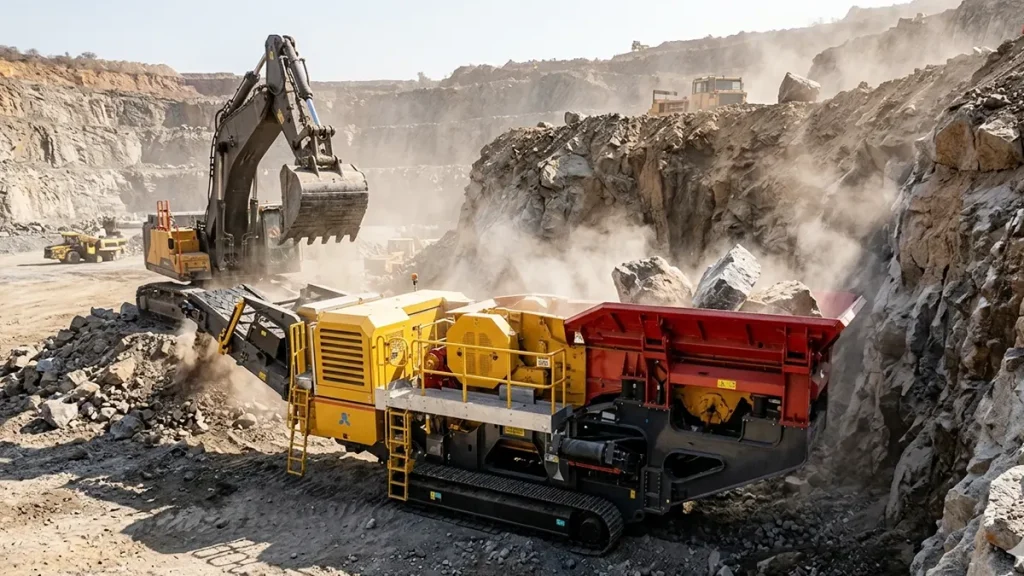
Deploying a Vertex VTJ1180 tracked unit directly to the blast face flips this economic model. The crawler tracks allow the primary crusher to advance with the excavation. The rock is crushed at the source and moved via high-efficiency overland belt conveyors, which consume a fraction of the utility power compared to a fleet of diesel-guzzling dump trucks. You are replacing unpredictable fuel overhead with stable, predictable electrical consumption.
Deploying a Vertex VTJ1180 tracked unit directly to the blast face flips this economic model. The crawler tracks allow the primary crusher to advance with the excavation. The rock is crushed at the source and moved via high-efficiency overland belt conveyors, which consume a fraction of the utility power compared to a fleet of diesel-guzzling dump trucks. You are replacing unpredictable fuel overhead with stable, predictable electrical consumption.
Comparing upfront prices without factoring in deployment speed and relocation value guarantees a failed financial model.
| System Configuration | Representative Model | Deployment Time | Internal Haulage Cost | 5-Year Asset Relocation Value |
|---|---|---|---|---|
| Stationary Fixed Plant | PEW860 / HPT300 | 30-45 Days | High (Dump Truck Fleet) | < 15% (Scrap Steel + Dismantling) |
| Pneumatic Wheeled Mobile | NK300H Secondary | < 24 Hours | Medium (Towable to Zones) | ~65% (Tow Intact) |
| Crawler Tracked Mobile | VTJ1180 Primary | < 4 Hours | Zero (Moves with Face) | ~60% (High Mechanical Wear) |
| Dual-Power Tracked | VTJ1180DP (250kW) | < 4 Hours | Zero (Grid Connected) | ~65% (Engine Preservation) |
The dual-power variants bridge the final cost gap. While mobile units traditionally rely on expensive diesel hydraulic drives, the 250 kW VTJ1180DP allows operators to plug directly into the local utility grid. This matches the exact low-cost energy rates of a fixed plant while preserving the geographic flexibility of a crawler chassis.
Salvage Value and the Hardware Amortization Cycle
Financial audits must project the end of the mine’s lifespan. After 5 to 7 years of operation, a fixed plant’s subterranean infrastructure cannot be relocated. Digging up concrete and dismantling heavy steel structures requires immense labor; often, the dismantling costs exceed the scrap value of the metal. The fixed asset essentially becomes a localized liability.
Mobile crushers are engineered as liquid assets. A pneumatic tire-mounted MK or NK series retains up to 65% of its initial hardware price because it can be detached, hitched to a standard semi-truck, and towed intact to a new highway contract the next morning. This high salvage value drastically flattens the asset amortization cycle, making mobile crushing an inherently lower-risk investment for mid-term projects.
300TPH Financial Friction: Fixed vs. Mobile Thresholds
- Foundation Sunk Cost: $0 on NK Series vs $100k+ on Fixed
- Production Initiation: Day 2 (Mobile) vs Day 45 (Fixed)
- Haulage Elimination: Vertex Tracks remove 30% diesel overhead
- Energy Parity: DP (Dual Power) matches fixed utility rates at 250 kW
- End-of-Life Liquidity: 65% retained value on wheeled chassis
Technical Index: LH-COST ANALYSIS OF MOBILE CRUSHER VS FIXED CRUSHER-FEB/2026-Ref-#48192
Liquidate Sunk Costs to Accelerate Amortization
Committing to stationary infrastructure in a transient aggregate market is a mathematical failure. A rigid Cost Analysis Of Mobile Crusher vs Fixed Crusher proves that burying capital in concrete and burning diesel on internal haulage destroys your expenditure per shift. Next month, if you sign a contract to build a fixed plant for a 3-year project, you are voluntarily surrendering your asset relocation value and delaying your capital payback velocity by 45 days. Deploy axle-mounted or tracked mobility and initiate production immediately.
Erase Haulage Friction and Audit Your Amortization Cycle
“What is your exact daily diesel consumption for internal rock transfer? Send us your haulage logs, and let’s calculate the financial impact of deploying a blast-face tracked primary.” — From the Desk of your The Investment Strategist
Calculate Your Payback Velocity
