


How To Crush Rocks To Make Gravel Aggregates?
Back in the November 2024 audit of the Solwezi, Zambia high-silica circuit, the most expensive mechanical failure wasn’t a snapped belt, but a fundamental misunderstanding of rock cleavage. Processing 185 MPa granite requires more than brute force; it demands a calculated reduction ratio that protects the grain shape. We deployed a C6X110 Jaw Crusher as the primary anchor, accepting a 720mm max feed boulder. The critical adjustment involved calibrating the Closed Side Setting (CSS) to exactly 125mm. Opening the primary jaw wider would have starved the secondary HPT cone, while closing it further would have generated useless fines, hemorrhaging potential revenue before the gravel was even sized.
The Physics of Grain Shape: Jaw-to-Cone Synchronization
A primary crusher prepares the size, but the secondary cone dictates the profit through cubicality.
When crushing rocks to make gravel aggregates, the primary jaw serves one engineering purpose: reducing the blast profile to a manageable feed size for the secondary stage. However, the jaw’s compressive action naturally produces elongated slabs along the granite’s internal stress lines. If these slabs enter a standard spring cone, they often slip through the chamber unchanged, resulting in a high flakiness index that fails G5 road-base audits. The transition to an HPT300 multi-cylinder cone crusher is the pivot point. By running the HPT300 at 850 RPM, we create a high-density material bed within the crushing cavity.
This inter-particle crushing physics forces rock to strike rock, rather than just hitting the manganese liners. This high-energy environment snaps the thin edges of elongated slabs, forcing the material into a cubical grain shape. In the Solwezi circuit, this mechanical synchronization increased the yield of 10-20mm gravel by 25% compared to local competitors using legacy spring technology. The production-to-cost ratio stabilized because the machine was working on the rock’s weaknesses, not just grinding against its hardness.
Managing Monsoon Moisture in High-Efficiency Screening
During the sub-tropical rainy season, the basalt and granite feed in many African circuits reaches a 12% moisture content. This turns the 0-5mm fines into a sticky industrial paste that blinds traditional 20mm mesh screens. A blinded screen is a dead circuit; it forces gravel back into the crusher, causing a “choking” effect that spikes motor load and overheats bearings. To arrest this, we integrated the S5X high-efficiency vibrating screen into the loop.
The S5X utilizes polyurethane panels and a high-amplitude stroke that physically ejects sticky material from the mesh. By adjusting the vibration amplitude, we maintained a consistent 280 tons per hour throughput despite the monsoon conditions. This feed continuity ensured the primary jaw never starved, keeping the mechanical utilization rate locked above 92.4%. Without this screening efficiency, the cost per ton of gravel aggregate would have doubled due to recirculating load friction.
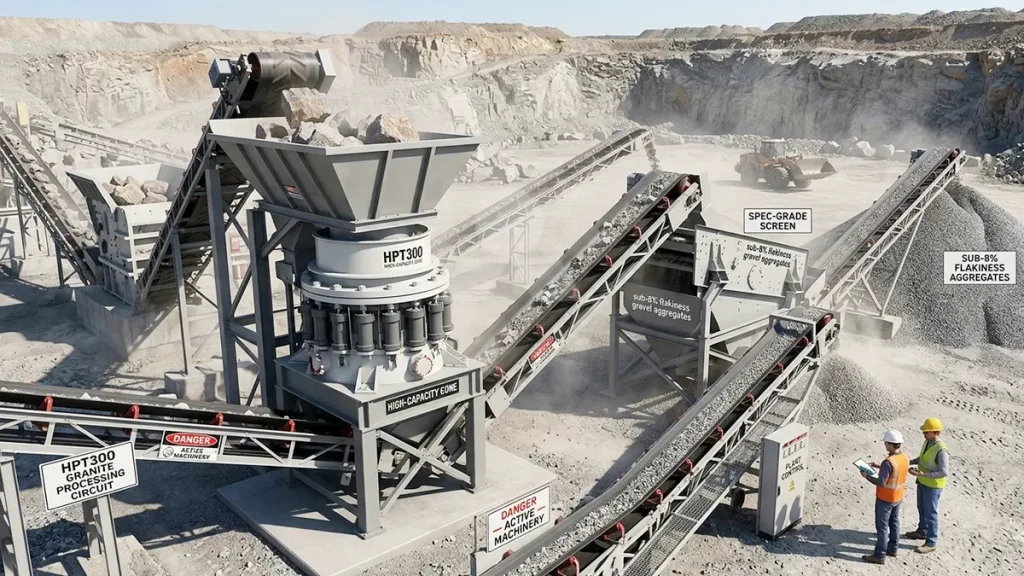
The following engineering blueprint outlines the synchronized equipment matrix required to sustain a high-capacity gravel production line in hard rock environments.
| Process Stage | Recommended Model | Capacity (tons per hour) | Power (kilowatts) | Max Feed (millimeters) |
|---|---|---|---|---|
| Primary Compression | C6X110 Jaw | 160-550 | 160 | 720 |
| Secondary Shaping | HPT300 Cone | 110-440 | 250 | 230 |
| High-Precision Screening | S5X1860-3 | 75-600 | 30 | 200 |
The C6X110 provides the massive volumetric intake required for primary reduction, while the 250 kW HPT300 cone refines the grain shape. This specific combination reduces the diesel fuel consumption to exactly 0.42 liters per ton when properly synchronized, significantly accelerating the capital payback velocity.
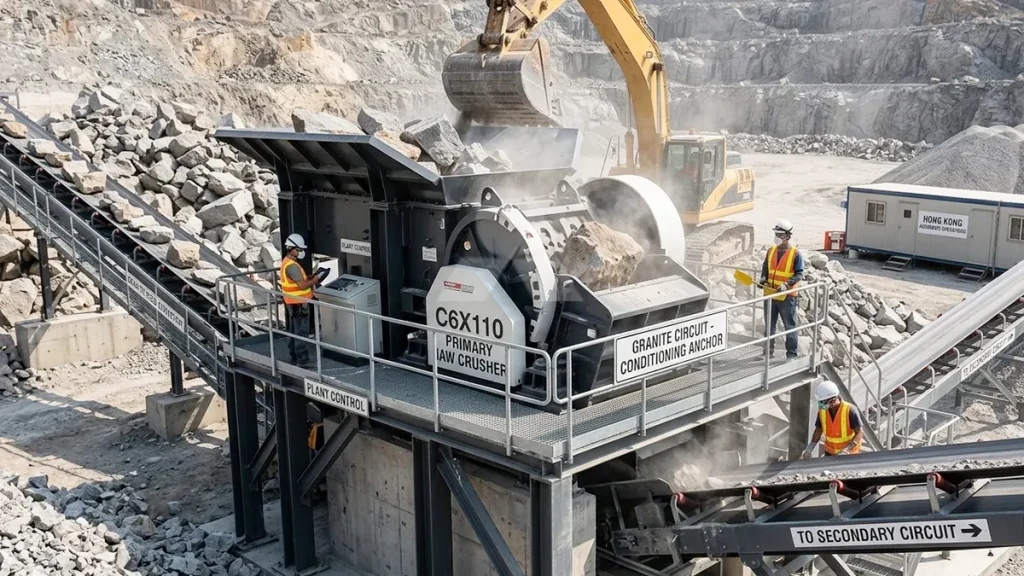
185MPa Granite Gravel Circuit: Output & Thermal Thresholds
- Primary Unit: C6X110 Jaw (160 kW)
- Secondary Unit: HPT300 Cone (250 kW)
- Screening Unit: S5X Series (Polyurethane Panels)
- Flakiness Target: <8% (G5 Aggregate Grade)
- Energy Overhead: 0.42 L/ton (Diesel Equivalent)
Technical Index: LH-HOW TO CRUSH ROCKS TO MAKE GRAVEL AGGREGATES-November/2024-Ref-#38291
Site Architect’s Memo: Grain Shape & Cavity Failures
- Why does a primary jaw crusher naturally produce elongated aggregate shapes?
- Look at the wear patterns on the jaw plates. The compressive action forces the rock to fracture along its weakest crystalline planes, which in granite leads to slabbing. This is why a jaw crusher can never be a standalone solution for high-grade gravel production; it merely prepares the feed for the shaping stage.
- How did we solve the flakiness issue in older aggregate circuits ten years ago?
- Ten years ago, we used to solve this by over-circulating material back into spring cones, which was an energy nightmare. We now use inter-particle crushing in multi-cylinder cones to snap those slabs in a single high-speed pass, drastically cutting the production-to-cost ratio.
- What happens if the lubrication system temperature exceeds 60°C in the HPT cone?
- Do not ignore the thermal expansion limits of your bronze bushings. If the oil temperature spikes, it indicates either a contaminated circuit or excessive dust infiltration. Ignoring this for even one shift will result in a seized main shaft, a catastrophe that kills your capital payback velocity instantly.
- Why is the S5X amplitude adjustment critical for monsoon aggregate processing?
- When you push beyond a 12% moisture content, the sticky fines require a higher G-force to separate from the gravel. By increasing the amplitude, we break the surface tension of the muddy fines, ensuring the screens remain clear and preventing the “carry-over” that contaminates your finished gravel stockpiles.
Arresting Bearing Thermal Failures in High-Capacity Circuits
The mechanical reality of gravel aggregate production is a race against heat and friction. If you ignore the 250 kW motor draw on your secondary HPT cone or allow the lubrication oil temperature to climb toward the thermal ceiling, you are inviting a catastrophic bearing seizure. This is not a matter of “if,” but “when.” Forcing a primary jaw to over-crush to compensate for a weak secondary stage only accelerates the wear-part expenditure per shift. Synchronizing your CSS with a closed-circuit HPT shaping stage is the only non-negotiable operational boundary that protects your capital assets. If you do not audit your lubrication cycles and bearing temperatures twice per shift, your entire 280 TPH production line will face a total mechanical shutdown before the end of next month.
Stop Guessing on Grain Shape and Bearing Load Limits
“Inter-particle crushing isn’t a feature; it’s a financial requirement for G5 aggregate survival.” — From the Desk of your Solution Architect
Audit Gravel Circuit Production-to-Cost Ratio
