


How to Choose the Right Limestone Jaw Crusher: Expert Buyer’s Guide
Limestone is one of the most common resources in the global construction and mining industries, widely used for cement production, concrete aggregates, and road base. However, for quarry owners and mining engineers, the challenge isn’t just finding limestone—it’s processing it efficiently.
Selecting the wrong primary crusher can lead to uneven particle sizes, frequent downtime, and skyrocketing energy costs. If you are wondering how to choose the right limestone jaw crusher for your project, you must look beyond just the price tag. Factors like feed size, required capacity, and the specific hardness of your quarry’s rock play a pivotal role.
At Liming Heavy Industry, we have decades of experience helping clients in Africa, Southeast Asia, and South America optimize their crushing lines. This guide will walk you through the essential technical criteria to ensure you invest in a machine that delivers high ROI.
1. Analyze Your Raw Material Characteristics
Before browsing catalogs, you must understand your material. Limestone is a sedimentary rock with a Mohs hardness of 3-4, which is considered soft to medium-hard. However, high silica content in some limestone deposits can increase abrasiveness.
- Compressive Strength: ensure the crusher can handle the maximum pressure of your stone (usually < 150 MPa for standard limestone).
- Moisture Content: If your limestone is sticky or wet (common in tropical regions), you need a jaw crusher designed with a deep cavity and no dead zones to prevent clogging.
2. Determine Your Production Requirements
Learning how to choose the right limestone jaw crusher largely comes down to the numbers. You must define three key metrics:
Maximum Feed Size
The crushing cavity must be large enough to accept the largest stones from your blasting stage. A general rule of thumb is that the maximum feed size should not exceed 85% of the crusher’s feed opening width. If your blasted stone is 500mm, you need a feed opening of at least 600mm.
Required Capacity (TPH)
Are you aiming for 100 tons per hour (TPH) or 800 TPH? Oversizing your machine wastes capital; undersizing it creates a bottleneck for the rest of your secondary crushers (like Cone Crushers or Impact Crushers).
Output Size
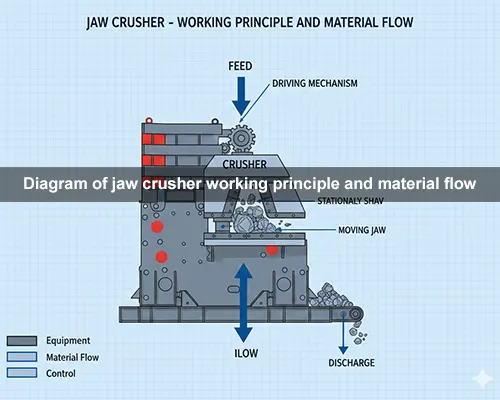
Jaw crushers are primary crushers. You need a model with an adjustable discharge setting (CSS) that matches the input requirement of your secondary crusher.
3. Compare Crusher Technologies: PE vs. PEW vs. C6X
Liming Heavy Industry offers different series of jaw crushers to match different budget levels and performance requirements. Understanding the difference is key to making the right choice.
| Feature | PE Series (Classic) | PEW Series (European) | C6X Series (High-End) |
|---|---|---|---|
| Technology Level | Traditional, Reliable | Modern Hydraulic | Advanced Intelligent |
| Crushing Ratio | Standard (4-6) | High (Start-up Friendly) | Ultra-High |
| Adjustment Method | Gasket/Shim (Manual) | Hydraulic Wedge | Double Wedge |
| Maintenance | Low Cost Parts | Easy Access | Minimal Downtime |
| Best For | Budget-conscious projects | Medium-scale modern plants | Large-scale, high-efficiency mines |
4. Stationary vs. Mobile Configuration
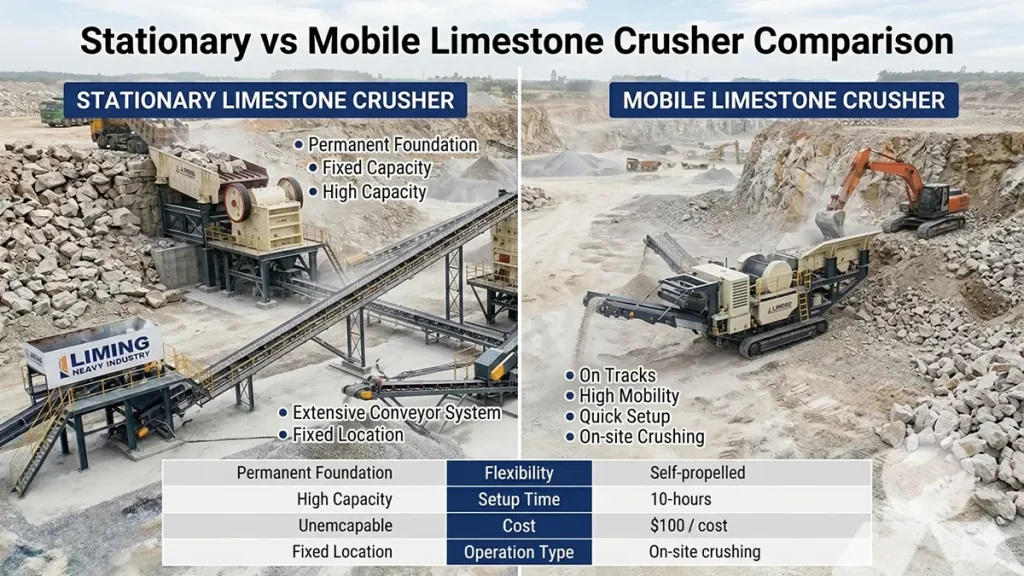
Another critical aspect of choosing the right crusher is deciding on mobility.
- Stationary Plants: Best for long-term quarries with a lifespan of 5+ years. They offer the lowest cost per ton but require concrete foundations and installation time.
- Mobile Crushing Stations: If your project involves multiple sites (e.g., road construction in Southeast Asia) or you want to reduce material hauling costs, a Liming Mobile Jaw Crusher is the superior choice. It eliminates infrastructure costs and goes directly to the mining face.
5. Frequently Asked Questions (FAQ)
Q1: Can a jaw crusher produce the final aggregate product?
Generally, no. A jaw crusher is a primary machine designed for coarse crushing. For limestone, it is usually followed by an Impact Crusher (for better shape) or a Cone Crusher (for harder rock) to produce the final 20mm or 40mm aggregates.
Q2: How do I maintain the lifespan of the jaw plates?
Limestone is not highly abrasive, but proper maintenance is still required. Regularly check the toggle plate, tighten bolts, and ensure the discharge opening is adjusted correctly. Liming uses high-manganese steel jaw plates to extend service life significantly.
Q3: What is the price difference between the PE and PEW series?
The PEW series (European style) generally costs more upfront due to its hydraulic adjustment systems and heavier manufacturing. However, for plants running 20 hours a day, the PEW offers lower operational costs (OPEX) and faster maintenance, providing a better long-term ROI.
Knowing how to choose the right limestone jaw crusher is about balancing your immediate budget with long-term operational efficiency. Whether you need the rugged reliability of the PE series or the high-tech efficiency of the C6X series, the goal is consistent throughput and minimal downtime.

