


250 TPH Desulfurization Limestone Crushing Process Technology
Advanced 250 TPH Desulfurization Limestone Crushing Process Technology
Executive Summary: The optimal 250 TPH desulfurization limestone crushing process technology integrates high-efficiency primary crushing with precise secondary shaping to produce uniform, high-reactivity limestone particles. Engineered for Flue Gas Desulfurization (FGD) systems, this configuration guarantees strict adherence to particle size requirements while significantly reducing energy consumption and operational downtime.
Addressing the Bottlenecks in FGD Limestone Preparation
For modern power plants and industrial facilities, the efficiency of a Flue Gas Desulfurization system relies heavily on the quality and consistency of the limestone absorbent. Operational bottlenecks often arise from high equipment maintenance costs, inconsistent particle sizes, and inflexible plant layouts. Implementing a proven 250 tph desulfurization limestone crushing process technology eliminates these inefficiencies. Drawing on decades of engineering expertise and strict ISO-certified manufacturing standards, Liming Heavy Industry provides crushing solutions that deliver the exact throughput and fineness required to neutralize sulfur dioxide emissions effectively, ensuring your operations remain environmentally compliant and highly profitable.
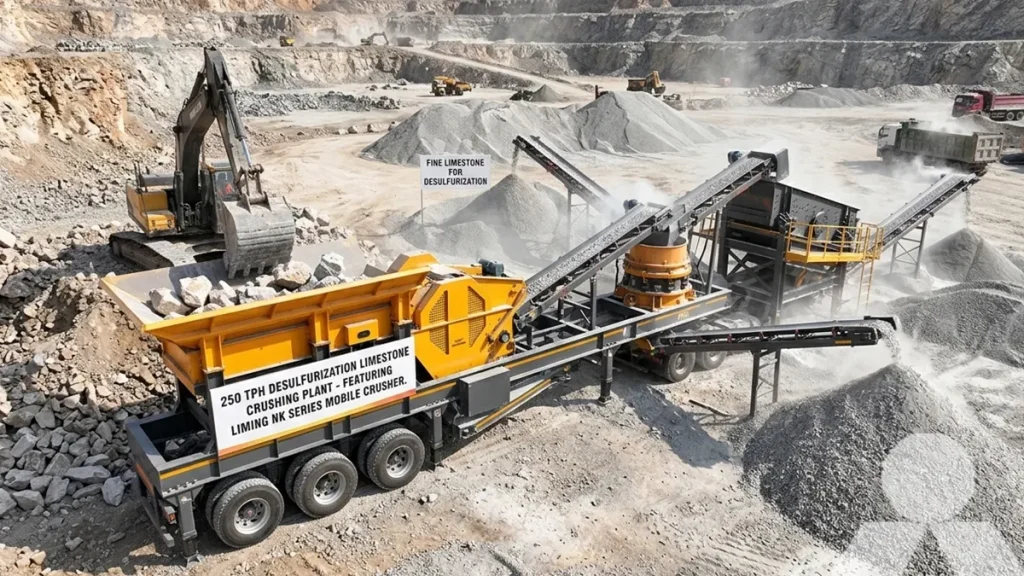
The 250 TPH Desulfurization Limestone Process Flow
To achieve a consistent 250 tons per hour, the process is divided into highly controlled stages. This step-by-step flowchart ensures maximum yield of the desired end product, typically ranging from 0-3mm depending on the specific boiler requirements.
1. Primary Crushing & Feeding
Raw limestone, often containing large boulders, is fed into the primary crushing stage via a vibrating feeder. For operations requiring rapid deployment and adaptability, we integrate the Liming NK series tire-based mobile crusher. This CE-certified unit eliminates the need for complex concrete foundations, allowing operators to position the crushing power directly at the extraction face, drastically reducing haulage costs.
2. Secondary Crushing & Precise Shaping
The output from the primary stage is conveyed to a secondary impact crusher or cone crusher. Limestone is a relatively soft material, making impact crushing highly effective for achieving excellent cubic shape. The robust design of our secondary crushers ensures high wear resistance, even under continuous 250 TPH loads.
3. Screening and Closed-Circuit Return
Material is then sent to a vibrating screen. Particles meeting the strict FGD size specifications are discharged as the final product. Oversized material is returned to the secondary crusher in a closed-circuit loop, guaranteeing 100% of the output meets the necessary desulfurization parameters.
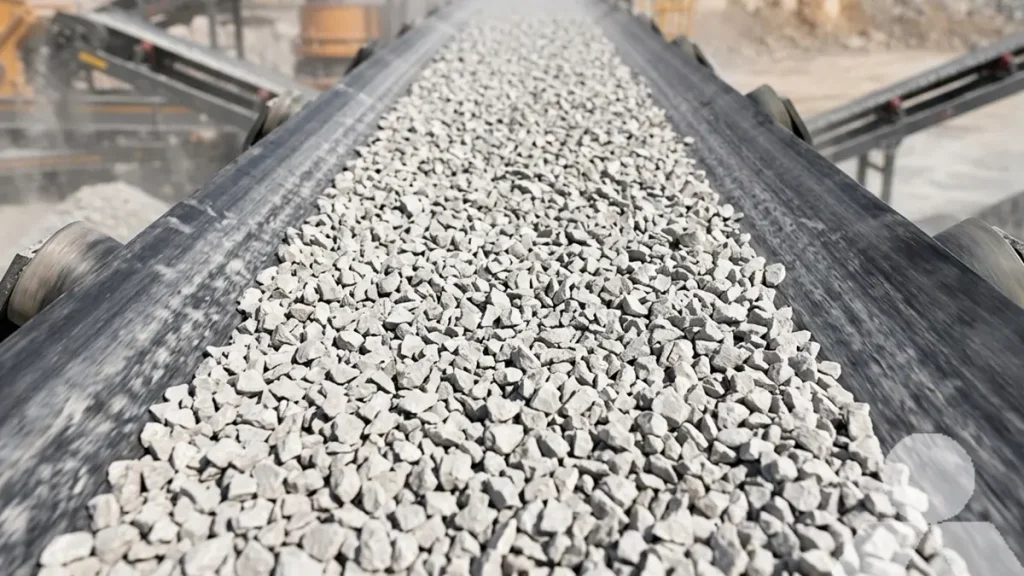
Technical Equipment Configuration & Capacities
Below is a standardized technical comparison table outlining the core equipment utilized in our 250 TPH solutions. This configuration balances upfront investment with long-term reliability.
| Equipment Type | Recommended Model | Max Feed Size (mm) | Processing Capacity (TPH) | Core Advantage for Desulfurization |
|---|---|---|---|---|
| Mobile Primary Crusher | Liming NK Series Tire-Based Mobile Jaw Crusher | Up to 600mm | 150 – 300 | Rapid deployment, eliminates foundation costs, high mobility. |
| Secondary Crusher | VSI6X Series Vertical Shaft Impact Crusher | 50mm | 100 – 300 | Excellent particle shaping, perfect for fine desulfurization powder. |
| Vibrating Screen | S5X Series Vibrating Screen | – | Up to 600 | High screening efficiency, strictly controls final particle size. |
Frequently Asked Questions (FAQ)
What is the ideal particle size for desulfurization limestone?
For most CFB (Circulating Fluidized Bed) boilers, the optimal limestone particle size is typically between 0-2mm or 0-3mm. Wet FGD systems may require further grinding into a fine powder (e.g., 250 mesh or 325 mesh) using a specialized grinding mill after the initial crushing process.
How does the 250 TPH capacity meet large power plant requirements?
A 250 TPH capacity is perfectly scaled for medium to large power plants. Operating for just 8-10 hours a day, this plant can stockpile 2,000 to 2,500 tons of high-quality desulfurization absorbent, ensuring a consistent, uninterrupted supply for continuous boiler operations.
Why utilize a tire-based mobile crusher for limestone processing?
The Liming NK series tire-based mobile crusher offers unmatched flexibility. It allows quarry owners to move the crushing plant as the mining face advances, significantly cutting down on dump truck fuel costs and emissions, while accelerating project ROI.
Investing in the correct 250 TPH desulfurization limestone crushing process technology is critical for maximizing sulfur capture and minimizing operational expenditures. By integrating advanced mobile solutions like the NK series with high-efficiency secondary shaping, operations can achieve exact material specifications with unparalleled reliability.

