


Reviewing the maintenance ledger reveals the truth. If the plant is shutting down twice a week to rotate or replace high-chrome blow bars, the expenditure per shift will eclipse the initial hardware savings within the first operating quarter. Abrasive silica mandates compressive, laminated crushing.
Wiki
Last Updated :2026-05-26 Views:338
Industrial Silica Sand Processing Plant Cost
Evaluating an aggregate investment model purely on the sticker price of the machinery is a fundamental fiscal error. During a financial audit of a high-capacity quartz facility in Western Australia this January 2026, the true Industrial Silica Sand Processing Plant Cost was exposed not in the initial purchase ledger, but in the daily maintenance logs. The operator had selected horizontal impact crushers to save on upfront capital. The 200 MPa silica vaporized the high-chrome blow bars in under 48 hours, paralyzing the production-to-cost ratio. When processing Mohs 7 abrasive minerals, the financial architecture must prioritize consumable survival over initial hardware savings to ensure a viable capital payback velocity.
The Trap of Upfront Equipment Price on Mohs 7 Silica
A low initial hardware price on abrasive rock guarantees an uncontrolled expenditure per shift.
Silica sand is relentless. Its crystalline structure acts as an industrial grinding agent against standard metallurgy. When investors attempt to lower the Industrial Silica Sand Processing Plant Cost by deploying budget-tier impactors or outdated spring cone crushers, they are merely deferring the payment. The intense kinetic friction will require constant replacement of blow bars, toggle plates, and mantle liners.
To stabilize the long-term balance sheet, the primary and secondary stages must utilize compression rather than blunt impact. Deploying a PEW860 jaw crusher for primary reduction ensures a steady, low-wear volumetric flow. This strategy requires higher initial capital but completely flattens the variable maintenance costs, allowing financial directors to accurately forecast monthly profitability without the threat of catastrophic downtime.
Fiscal Efficiency of Laminated Crushing (HPT Cone)
The secondary crushing stage dictates the survival of the entire financial model. An HPT300 multi-cylinder hydraulic cone crusher represents a significant portion of the plant’s budget, but its physical mechanics justify the allocation.
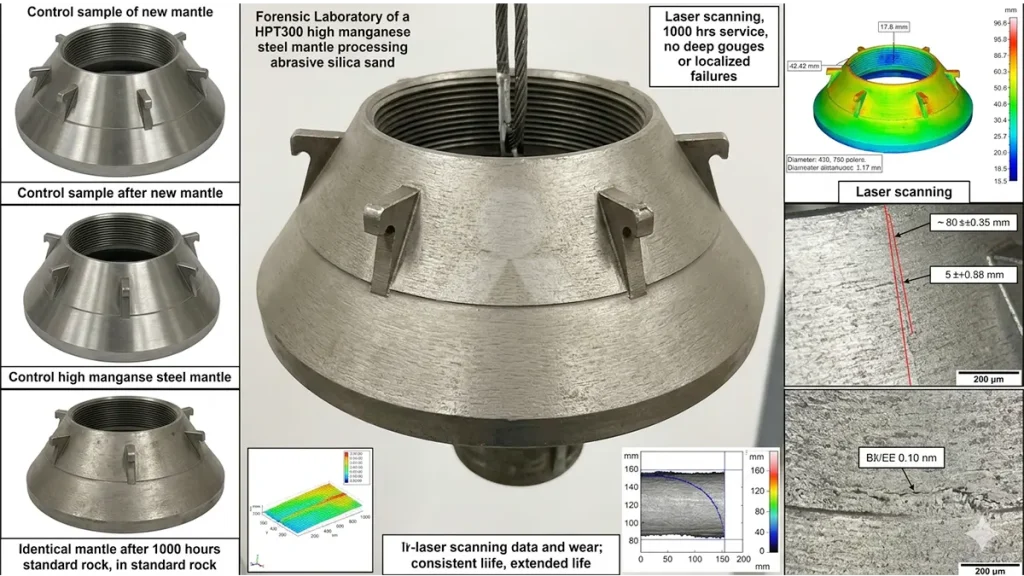
Utilizing 250 kW of power, the HPT300 executes laminated crushing. Instead of the machine’s steel absorbing the abrasive friction, the silica rocks are compressed against each other in a dense bed. They fracture along their natural grain boundaries. This physical transfer of destructive energy away from the machine’s wear parts drastically reduces the daily consumable overhead, ensuring the asset amortization cycle remains highly profitable.
A synchronized configuration matrix reveals the true fiscal footprint of a high-purity silica operation.
| Process Stage | Recommended Equipment | Capacity (tph) | Power (kW) | Financial Justification |
|---|---|---|---|---|
| Primary Reduction | PEW860 Jaw Crusher | 200-500 | 132 | Low-wear volumetric anchoring |
| Secondary Sizing | HPT300 Cone Crusher | 110-440 | 250 | Laminated fracture mitigates abrasion |
| High-Purity Shaping | VSI6X1150 Sand Maker | 344-663 | 500 (250×2) | Prevents iron contamination |
| Purification / Washing | XSD3220 Wheel Washer | 60-150 | 15 | Converts waste into commercial grade |
Integrating the VSI6X1150 as the core shaping engine requires dual 250 kW motors. While this increases the electrical baseline, it is the only mechanical method guaranteed to produce the premium, zero-iron-contamination sand demanded by high-margin glass and foundry markets.
Protecting Margin with Stone-on-Stone Kinematics
High-purity silica sand commands a premium market price, but buyers maintain a zero-tolerance policy for iron contamination. Standard crushing equipment introduces microscopic iron shavings into the aggregate as the metal wear plates degrade. This metallurgical flaw instantly devalues the final product, destroying the revenue model.
The VSI6X vertical shaft impactor eliminates this risk. It accelerates the pre-sized silica to 70 meters per second, ejecting the rock into a stationary bed of material built up along the cavity wall. This “stone-on-stone” kinetic collision ensures the silica fractures against itself rather than against steel armor. By preserving the chemical purity of the sand, the VSI6X directly protects the premium sales margin of the entire operation.
Mohs 7 Silica Plant: Fiscal & Kinematic Thresholds
- Consumable Attrition Rate: >300% longer lifespan using HPT Cone vs Impactor
- Iron Contamination Limit: Maintained near zero via VSI stone-on-stone cavity
- Kinetic Power Allocation: 500 kW (250×2) dedicated to tertiary shaping
- Fine Sand Recovery Value: Captures up to 15% of previously lost 0.16mm yield
- Capital Payback Velocity: Accelerated via premium product grading
Liquidating Hidden Waste in the Washing Circuit
The final financial bottleneck in a silica plant often occurs at the discharge chute. Kinetic shaping inevitably produces a percentage of -200 mesh rock dust. Unwashed silica sand containing excess silt is unsellable for high-grade applications. Integrating an XSD3220 wheel washer removes this impurity, but traditional washing systems inadvertently flush highly valuable 0.16mm fine sand into the settling ponds.
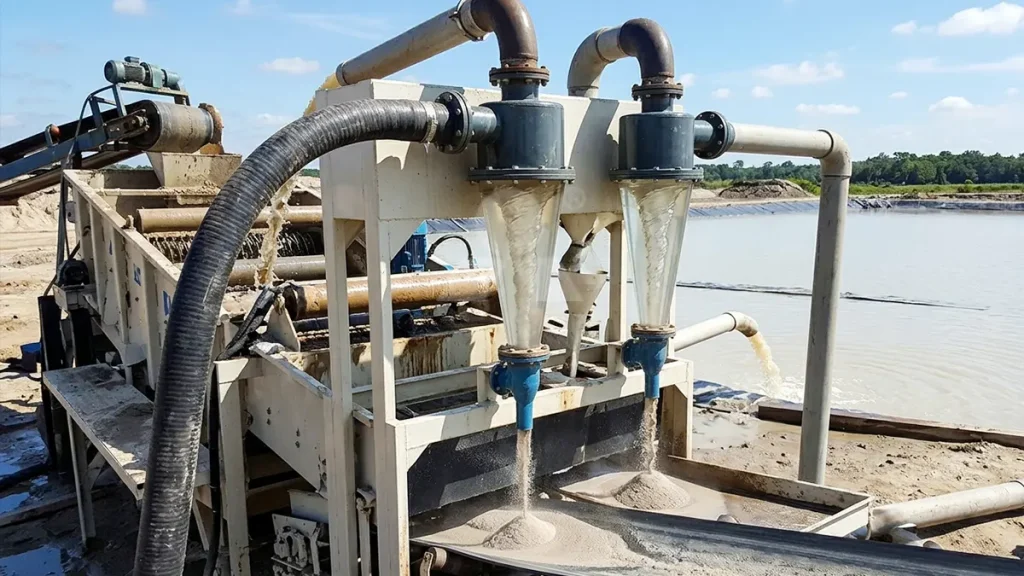
This is a direct hemorrhage of liquid assets. By integrating a fine sand recovery unit alongside the washing wheel, operators capture this microscopic premium sand. This precise hydro-separation prevents yield loss and strictly controls the final fineness modulus, maximizing the plant’s daily revenue generation.
Fiscal Attrition Diagnostics & Consumable Overhead Post-Mortem
Decades ago, financial models often grouped silica sand with standard limestone aggregates. They failed to account for the exponential increase in abrasive wear caused by the Mohs 7 hardness. A modern financial blueprint isolates the metallurgical friction and budgets for heavy-duty cone crushers accordingly.
A 500 kW dual-motor drive consumes significant power, but this energy is directly converted into premium aggregate geometry. The VSI eliminates micro-cracks and prevents iron contamination. The resulting high-grade glass sand commands a market price that instantly justifies the utility costs.
Calculating the volumetric loss proves that traditional washers flush up to 15% of the fine sand away. Over a five-year contract, recovering that 15% adds millions to the bottom line, radically flattening the asset amortization cycle of the entire washing circuit.
Audit Your Abrasive Friction to Accelerate Amortization
An industrial silica operation is a high-stakes financial engine; it does not tolerate under-capitalized machinery. A rigid evaluation of the Industrial Silica Sand Processing Plant Cost proves that prioritizing initial hardware savings on abrasive quartz will inevitably destroy your expenditure per shift. Next month, if you sign a contract for a blunt-force impact circuit, you are voluntarily surrendering your profit margins to catastrophic metal wear and iron contamination. Deploy laminated cone crushers and stone-on-stone kinematics to secure a rapid capital payback velocity.

