


Manufactured Sand in Railway Construction: Standards & Equipment
Enforcing Structural Compliance in Manufactured Sand in Railway Construction: Standards & Equipment Deployments
Dynamic Shear Forces and the VSI6X Mandate
Flaky aggregate is an invisible structural void.
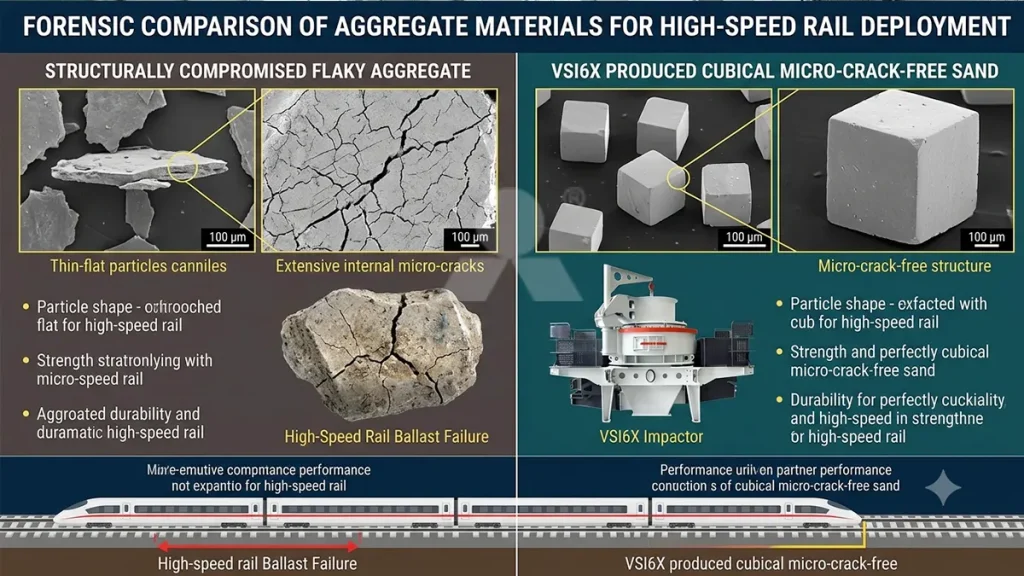
The foremost compliance failure in railway aggregate production is the flakiness index. Standard compressive machines, such as jaw and cone crushers, rely on sheer pressure to break rock. This action inherently shears the stone along flat planes, generating elongated, flaky slivers. When mixed into HSR concrete, these sharp edges create microscopic voids, preventing the cement paste from achieving maximum density.
Under the extreme dynamic shear forces of a bullet train, these voids become fracture points.
Railway standards strictly cap the flakiness index at <8%. The only mathematically viable method to achieve this is deploying a VSI6X sand maker as the tertiary finisher. The VSI utilizes 400kW of dual-motor rotational energy to hurl the flaky aggregate into a stationary rock bed at lethal velocities. This rock-on-rock kinetic collision physically chips away the sharp edges, curing the grain geometry into perfectly structural-grade cubical aggregate. If your plant lacks a VSI, your sand is legally unfit for railway deployment.
Micro-Crack Obliteration and Concrete Fatigue
Beyond external shape, the internal integrity of the aggregate dictates the infrastructure amortization cycle. Compressive crushers (cones and jaws) subject the rock to immense hydraulic pressure. While this breaks the rock, it also inherently induces microscopic internal fissures (micro-cracks) deep within the aggregate structure.
Field Note: I audited a suspended rail viaduct in Southeast Asia where the concrete pylons exhibited premature micro-spalling. The contractor had used pure cone-crushed aggregate. The decades of continuous train vibration caused the pre-existing micro-cracks in the sand to propagate, triggering severe concrete fatigue.
In a railway environment, these micro-cracks are a compliance liability. The VSI6X serves a dual purpose here. The violent centrifugal impact inside the rotor does not just shape the rock; it acts as an extreme stress test. Any stone harboring internal micro-cracks will shatter completely upon impact. The VSI physically obliterates these weakened stones before they can enter the supply chain, ensuring that only the absolute strongest, internally flawless cubic grains reach the batching plant.
Meeting strict HSR compliance dictates a rigid, non-negotiable equipment matrix.
| Compliance Standard | Target Parameter | Mandatory Equipment | Architectural Function |
|---|---|---|---|
| Flakiness Index | < 8% | VSI6X1040 | Kinetic Rock-on-Rock Shaping |
| Fineness Modulus (FM) | 2.6 – 3.0 | S5X Closed-Circuit Screens | Strict Geometric Looping |
| Mud Content | < 1.0% | Dual XSD Washers + Hydrocyclones | Chemical Bond Preservation |
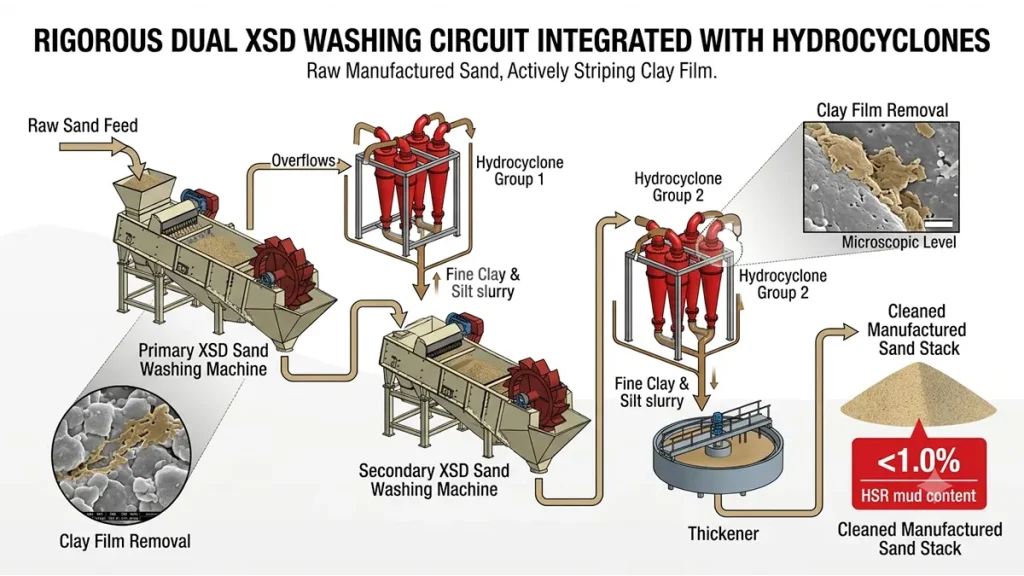
Analyze the Mud Content threshold. A 1.0% limit is an extremely tight margin. A single wash wheel cannot achieve this on high-volume production without sacrificing the Fines Modulus.
Fineness Modulus and Closed-Circuit Discipline
Railway ballast and track-bed concrete dictate a strict Fineness Modulus (FM) of 2.6 to 3.0. The gradation curve must be perfectly smooth. If an operator utilizes open-circuit crushing without a strict S5X screening return loop, the resulting aggregate will drift out of spec immediately.
A drifting FM triggers instant batch rejection by government infrastructure inspectors.
The architecture must incorporate a rigid closed-circuit mass balance. Any material exiting the VSI that falls outside the required geometric parameters must be caught by the S5X vibrating screens and continuously recirculated. Furthermore, the washing phase must be carefully calibrated. Washing 200 tph of aggregate through a single, uncalibrated wheel washer leaves a residual clay film on the sand, destroying the chemical bond with the cement paste. Dual XSD washers coupled with hydrocyclones are mandatory to enforce the <1.0% mud content threshold while preserving the critical 0.15mm fines needed to lock in the FM score.
HSR Manufactured Sand: Compliance Thresholds
- Kinetic Shaping: VSI6X1040 enforcing <8% flakiness index
- Structural Integrity: 100% elimination of micro-fissured grains via impact
- Gradation Control: Strict 2.6-3.0 FM maintained via S5X closed-loop
- Chemical Purity: Clay film completely stripped via dual XSD desliming
- Moisture Mandate: Reduced to <15% via high-frequency dewatering
Enforce Absolute Geometric Obedience
Supplying aggregate to a national railway project is not a standard commercial contract; it is a legally binding commitment to structural survival. If you attempt to bypass the tertiary shaping stage or utilize an open-circuit washing layout next month, your flaky, mud-contaminated aggregate will trigger an immediate compliance liability. The architecture demands a VSI6X sand maker to execute kinetic rock-on-rock shaping, obliterating micro-cracks and curing the flakiness index to <8%. Dual XSD washers must be deployed to enforce the <1.0% mud threshold.

