


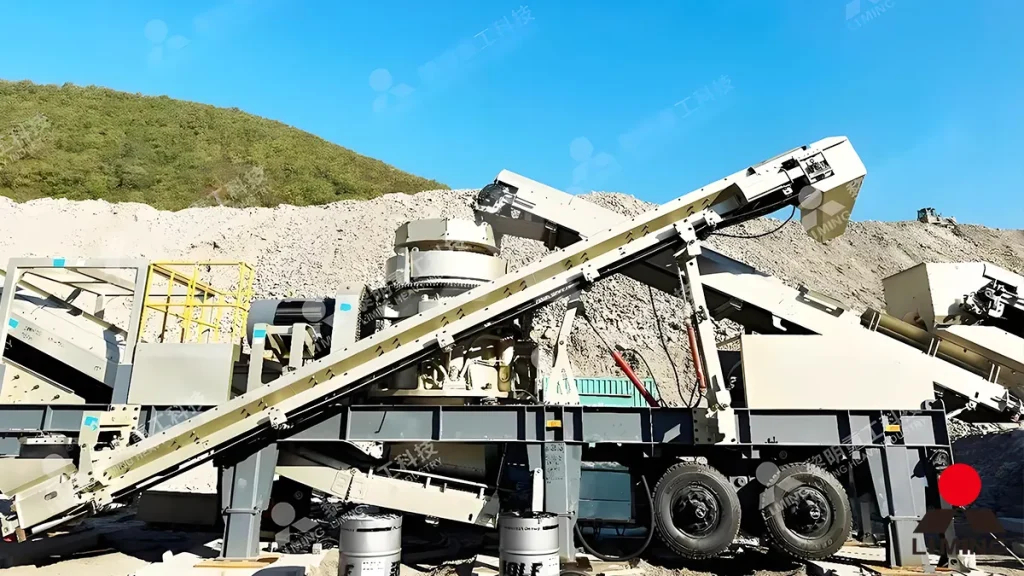
A 250kW crusher generates violent dynamic forces. Standard portable frames bounce on their tires, causing structural fatigue. The NK series deploys high-tonnage hydraulic legs that physically lift the tires off the ground, transferring the dynamic energy directly into the compacted earth and acting as a solid kinetic counterweight.
Wiki
Last Updated :2026-07-24 Views:438
Complete guide to portable crusher plant
Architecting a mobile processing facility requires abandoning flat-land stationary logic entirely. A portable crushing setup is not merely a jaw or cone bolted to a trailer; it is a compressed, closed-circuit kinetic factory. Pouring a 400-cubic-meter concrete foundation freezes your budget and delays active extraction for up to 45 days. Mastering portable architecture demands understanding wheeled-towing physics, hydraulic support leg dispersion, and the spatial consolidation of feeding, crushing, screening, and return logistics onto heavy-duty pneumatic tire-mounted frames.
Wheeled-Towing Physics and Hydraulic Stabilization
A portable plant must ground its kinetic violence into the earth without concrete footings.
When a 250kW crusher operates at peak capacity, the eccentric shaft generates violent vibration harmonics. Stationary plants absorb this energy through massive concrete foundations. A portable plant achieves the same structural defense through hydraulic engineering. The Liming NK Series is engineered strictly on a heavy-duty pneumatic tire-mounted portable crusher chassis.
High-tonnage hydraulic support legs extend directly onto compacted gravel.
This lifts the pneumatic tires off the ground, transforming the steel frame into a solid kinetic counterweight. The dynamic load of the crushing chamber dissipates directly into the earth. This eliminates the 45-day civil engineering curing window, allowing an operator to transition from highway transit to active 300 tph aggregate processing in under 48 hours.
Single-Chassis Centralization: The 4-in-1 Architecture
For medium-soft rock like limestone (<150MPa), stretching equipment across a quarry floor introduces unnecessary transfer conveyors. Every transfer point is a mechanical liability that draws power and demands maintenance. The ultimate spatial efficiency is achieved through single-chassis centralization.
The NK1213C centralizes four major processing nodes onto a single frame.
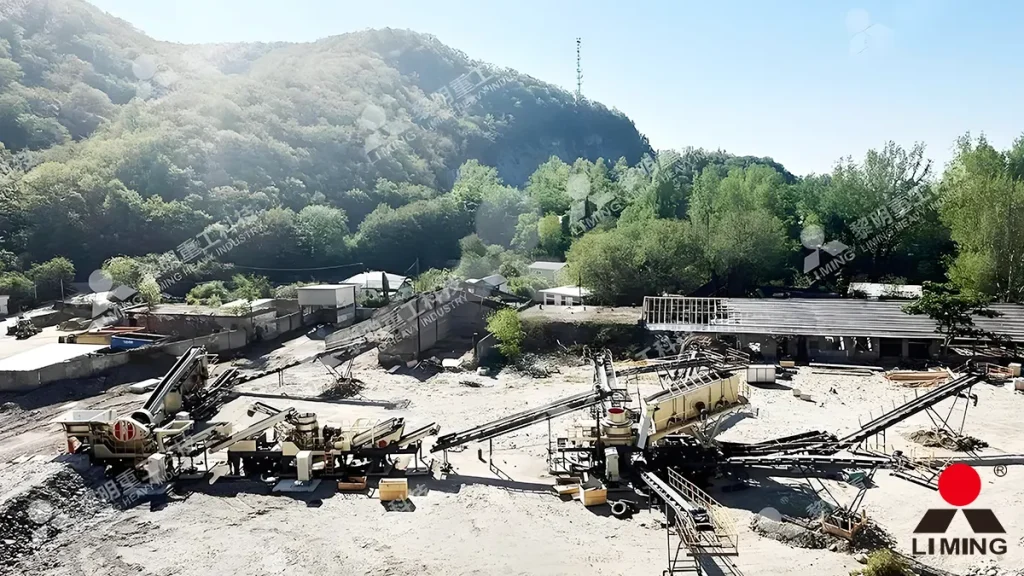
It integrates an FK0936 vibrating feeder, a CI5X1213 impactor, an SKX vibrating screen, and an onboard folding return conveyor. This 4-in-1 spatial geometry compresses a 150-300 tph extraction loop into a tight 15-meter operational radius. By eliminating independent transfer belts, the production-to-footprint ratio skyrockets while drastically reducing the overall electrical expenditure per shift.
Selecting the correct portable configuration depends strictly on the target geology’s compressive strength.
| Process Node | Recommended Portable Model | Capacity (tons per hour) | Geological Application |
|---|---|---|---|
| Primary Extraction Chassis | NK75J (PE3040 Jaw) | 150-350 | Primary reduction of raw blast boulders |
| Secondary Lamination Chassis | NK300H (HPT300 Cone) | 110-440 | Hard, abrasive rock (>200MPa Granite/Basalt) |
| Integrated 4-in-1 Chassis | NK1213C (CI5X Impactor) | 150-300 | Medium-soft rock (<150MPa Limestone/Recycling) |
Analyze the power rating of the NK300H secondary cone chassis. Delivering 283kW of drive power on a mobile frame allows high-RPM lamination crushing to occur directly at the quarry face, bypassing static plant erection entirely.
Hard Rock Adaptation and Closed-Circuit Looping
Deploying a single-chassis impactor onto 200MPa abrasive granite is an architectural death sentence. The high silica content will vaporize the steel blow bars in under 48 hours. For hard rock, the guide mandates a multi-vehicle portable matrix: a primary tire-mounted jaw unit (NK100E) feeding a secondary tire-mounted multi-cylinder cone unit (NK300H).
The secondary cone uses lamination to force the rock to crush itself.
Furthermore, open-circuit portable crushing guarantees geometric failure at the discharge pile. To meet strict civil engineering aggregate specifications, the portable setup must integrate an S5X closed-circuit screening matrix. Any oversized +40mm rock exiting the crusher deck is caught by the screen and automatically conveyed via an onboard folding belt back into the crushing chamber. This continuous loop traps the rock until it submits to the calibrated Closed Side Setting (CSS), preventing product contamination and stabilizing your circuit amortization cycle.
Field Note: I audited an open-circuit portable deployment in West Africa. The operator allowed 50mm uncrushed slabs to bypass the screen directly into the base-course stockpile. The entire 2,000-ton lot was rejected by highway inspectors, forcing a costly re-crushing operation that wiped out their shift margin.
Pneumatic Portable Plant: Spatial & Kinetic Integration Thresholds
- Chassis Architecture: Heavy-duty pneumatic tire-mounted chassis
- Setup Velocity: <48 hours via hydraulic support leg deployment
- Civil Engineering Requirement: 0 cubic meters of concrete
- Hard Rock Matrix: Dual-chassis Jaw (NK100E) + Cone (NK300H)
- Gradation Defense: Onboard SKX closed-circuit return loop
Spatial Consolidation & Mass Flow Integration Verdict
For medium-soft limestone, connecting separate mobile units via long conveyors wastes space and introduces belt tracking failures. The NK1213C centralizes the feeder, impactor, screen, and return belt onto one frame, executing a closed 150-300 tph extraction loop within a tight 15-meter radius.
Granite contains high concentrations of silica. High-speed impact blow bars will vaporize under this abrasive friction in 48 hours. Hard rock requires a multi-vehicle portable setup: a primary jaw chassis feeding a secondary multi-cylinder HPT cone chassis to enforce lamination crushing.
An open-circuit setup allows uncrushed +40mm slabs to pass directly onto the discharge pile, contaminating the aggregate. An integrated SKX vibrating screen and hydraulic folding return belt physically trap oversized rock, forcing 100% of the output to comply with strict civil engineering specifications.
Enforce Portable Architecture Discipline
Deploying a portable crushing plant is a strict exercise in spatial and kinetic management. You cannot treat a mobile chassis like a stationary plant, nor can you ignore the crushing physics of your target geology. If you attempt to force an impactor onto 200MPa granite, or operate an unbuffered open-circuit setup next month, your mass balance deficit and wear-part destruction will permanently paralyze your circuit amortization cycle. You must deploy pneumatic tire-mounted chassis to eliminate civil engineering delays, match your machinery to rock hardness, and enforce closed-circuit return loops.
Deploy your hydraulic support legs and secure your spatial mass flow immediately.

