


Basalt Crushing and Sand Making Project
Summary:Basalt is a notoriously hard and highly abrasive volcanic rock, making it an excellent material for highway asphalt and high-strength concrete, but extremely difficult to process. This engineering guide explores a massive 3.4 million tons-per-year basalt crushing and sand making project located in Zhejiang, China. Designed by Liming Heavy Industry, the plant utilizes a strict lamination crushing circuit—featuring Jaw Crushers and Multi-Cylinder Cone Crushers—combined with Vertical Shaft Impactors to minimize wear part consumption and produce premium cubic manufactured sand.
Project Background and Overview
Zhejiang Province has long been a model for the modernization and construction of green, environmentally friendly mines in China. Recently, in this beautiful region, a massive high-quality aggregate production line was successfully commissioned. Recognizing the extreme difficulty of processing hard rock, the client sought a partner with proven expertise and chose to collaborate exclusively with Liming Heavy Industry. From the initial process flowsheet design to equipment installation and factory construction, our engineering team delivered a complete turnkey solution.
- Project Scale: 3.4 million tons per year
- Processed Material: Natural Basalt
- Finished Product Sizes: 0-3mm, 3-5mm, 5-10mm, 10-15mm, and 15-26.5mm
- Equipment Configuration: Jaw Crusher + Single-Cylinder Cone Crusher + Multi-Cylinder Cone Crusher + Vertical Shaft Impactor (Sand Maker) + Vibrating Screens + Vibrating Feeders
- Processing Method: Dry processing
- End Application: Premium aggregate for highway asphalt
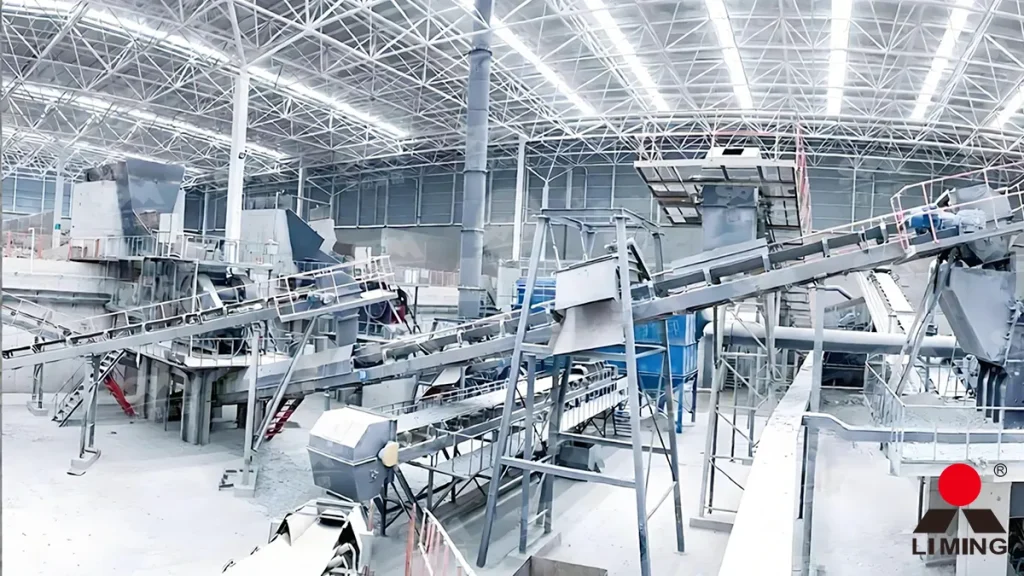
To establish this site as a benchmark green mining production line, the entire project was designed strictly according to the concepts of “digitalization, intelligence, and green manufacturing.” During the planning phase, our resident engineers conducted extensive topographical surveys to customize the plant layout. By adopting an intensive, modular design approach, we significantly reduced the amount of land, conveyor belts, and electrical cabling required. The overall factory layout is scientifically organized, ensuring the client achieves their lean production management goals.
Understanding Basalt Characteristics and Processing Challenges
Basalt is an extrusive basic volcanic rock. Its chemical composition is similar to gabbro, with a high silica (SiO2) content ranging from 45% to 52%, alongside aluminum oxide, iron oxide, and calcium oxide. Its bulk density is high, typically between 2.8 and 3.3 grams per cubic centimeter. Dense basalt is exceptionally tough, with compressive strengths frequently reaching up to 300 megapascals.
Because of its immense hardness, toughness, and high silica content, basalt is notoriously difficult and expensive to crush. If improper equipment is selected (such as impact crushers), the wear on consumable parts—like blow bars and impact plates—is catastrophically high. Therefore, the processing circuit must be designed with extreme care to balance initial capital investment with long-term operating costs. Engineers must prioritize “lamination crushing” equipment (crushers that rely on compressive squeezing) to mitigate wear.
Core Equipment Selection for Basalt Processing
For this mega-project, Liming Heavy Industry selected an elite combination of host machinery to ensure both sand generation and high-quality aggregate shaping.
1. Primary Crushing: Jaw Crusher
The C6X Series Jaw Crusher utilizes a deep V-shaped crushing cavity with no dead zones, drastically improving the feeding capacity and throughput. Its optimized kinematic parameters ensure that the rock begins to crush at the very top of the chamber, providing a massive crushing ratio. The heavy-duty compressive mechanism easily handles massive basalt boulders, breaking them down with minimal wear to the manganese jaw plates.
2. Secondary and Tertiary Crushing: Cone Crushers
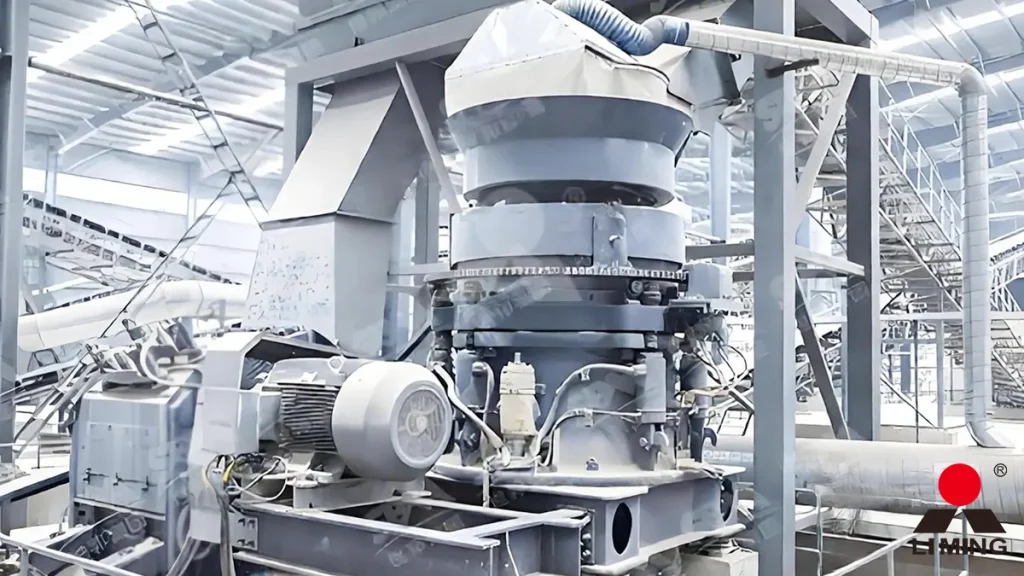
Because impact crushers wear out too quickly on basalt, the secondary and tertiary stages rely entirely on hydraulic cone crushers. We configured the plant with both the HST Single-Cylinder Cone Crusher and the HPT Multi-Cylinder Cone Crusher. Operating on the lamination crushing principle, the basalt is squeezed and fractured against itself inside the chamber. This “rock-on-rock” internal friction produces uniform particle sizes while drastically extending the operational lifespan of the steel mantles and bowl liners.
3. Sand Making and Shaping: Vertical Shaft Impactor (VSI)
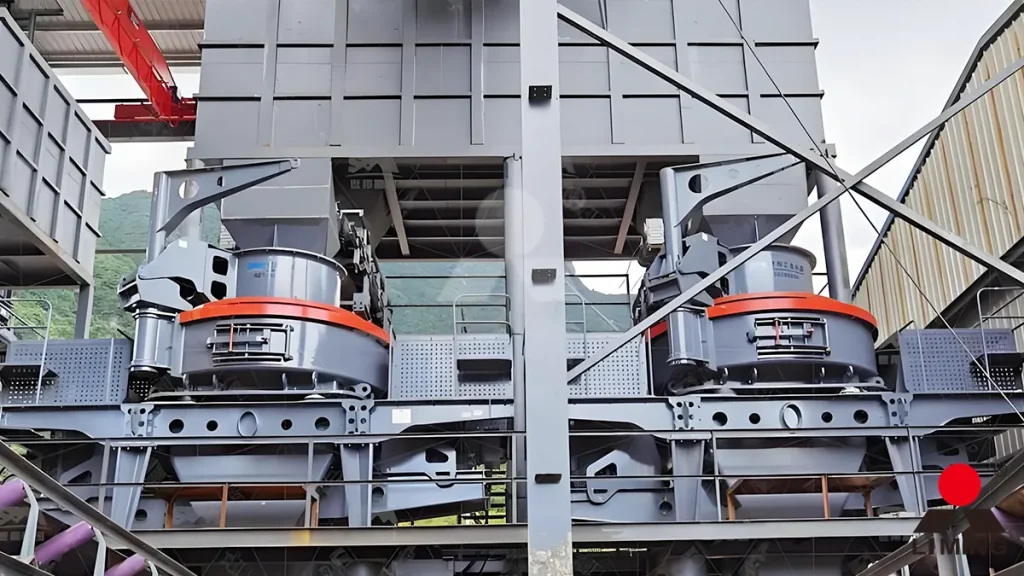
While cone crushers are cost-effective, they tend to produce a higher percentage of flat or needle-like stones. To meet the strict cubicity requirements for highway asphalt, the material must be reshaped. The VSI6X Series Sand Maker was installed for this purpose. Using a high-velocity “rock-on-rock” collision principle, the VSI knocks off the sharp edges of the basalt, producing perfectly cubic aggregate and high-quality 0-3mm fine manufactured sand. The equipment features modular wear parts and a self-circulating airflow chamber that minimizes dust emissions.
The Engineered Process Flow
The production line employs a sophisticated “three-stage crushing and one shaping” process flow to guarantee the quality of the final aggregate.
- Primary Reduction: Large basalt rocks are fed evenly by a vibrating feeder into the jaw crusher. The primary crushed material is then conveyed to an intermediate stockpile.
- Secondary Fine Crushing: The material is fed into the single-cylinder and multi-cylinder hydraulic cone crushers. This stage significantly reduces the particle size.
- Closed-Circuit Screening: The output from the cone crushers is transported to a multi-deck circular vibrating screen. Stones larger than 40mm are sent back to the cone crushers for further reduction.
- Tertiary Sand Making and Shaping: The basalt particles under 40mm are sent into the VSI sand maker. Here, the stones are violently accelerated and shattered against each other.
- Final Classification: The shaped material exits the VSI and is screened again. Material larger than 20mm is returned to the VSI for re-crushing. Material under 20mm is precisely classified into the required commercial sizes and transported to fully enclosed product storage silos.
Intelligent and Green Manufacturing Design
To align with national environmental protection standards, the entire project utilizes a dry production process housed within fully enclosed factory buildings. Micro-mist dust suppression systems are installed at all critical dust-generating points (such as crusher inlets and conveyor transfer points) to effectively mitigate airborne particles and control fugitive emissions.
Furthermore, the facility relies heavily on intelligent control systems. Operators in the central control room can monitor and manage the entire production line, implementing automatic overload protections and automated truck loading protocols. This digital integration significantly lowers manual labor requirements and overall production management costs.
Industrial Applications of Processed Basalt
After undergoing deep mechanical processing, the high-quality basalt aggregates and manufactured sand from this project serve vital roles across multiple industries:
- Premium Aggregate for Lightweight Concrete: Vesicular basalt (pumice) is highly porous yet extremely rigid. When mixed into concrete, it reduces the overall dead weight of high-rise structures while maintaining immense structural integrity. It provides excellent acoustic and thermal insulation properties.
- High-Grade Highway and Railway Foundation: Due to its strong compressive strength, extremely low crushing value, low water absorption, and excellent adhesion to asphalt, crushed basalt is the premier material for highway surface layers, airport runways, and railway ballasts. It ensures unparalleled wear resistance and longevity under heavy traffic loads.
- Raw Material for “Cast Stone”: Basalt is melted, cast, and annealed to create cast stone materials. This finished product is harder and more wear-resistant than alloy steel, and more corrosion-resistant than lead or rubber.
Partnering with Liming Heavy Industry
For over 30 years, Liming Heavy Industry has been a formidable force in the aggregate equipment manufacturing industry. We continuously elevate our manufacturing craftsmanship and material metallurgy to help mining enterprises drastically lower their production costs. Today, we have successfully assisted clients globally in building intelligent, green aggregate demonstration parks.
During the final installation phase of this Zhejiang project, a dedicated service team of nearly 100 engineers from Liming Heavy Industry was stationed on-site, working relentlessly to ensure the project was commissioned flawlessly. We look forward to partnering with more enterprises to deliver world-class mineral processing solutions.

