


Cone Crusher Selection Guide For Copper Ore Processing
Processing copper ore requires specialized comminution equipment because the valuable copper is intimately intergrown with highly abrasive quartz and pyrite gangue. This engineering guide details cone crusher selection for copper ore processing. Written by a senior process engineer at Liming Heavy Industry, the article explains why the “Three-Stage Closed-Circuit” flowsheet—utilizing the HST Single-Cylinder Cone Crusher for secondary reduction and the HPT Multi-Cylinder Cone Crusher for tertiary fine crushing—perfectly executes the “more crushing, less grinding” principle to drastically lower long-term operating expenses.
While the primary copper minerals themselves are not exceptionally hard, they are nearly always geologically intergrown with highly abrasive quartz and pyrite gangue. Therefore, the crushing circuit must be designed to withstand severe mechanical wear. The mainstream industry standard configuration is the “Jaw Crusher + Cone Crusher” circuit. Within this system, the cone crusher bears the massive responsibility of the secondary (medium) and tertiary (fine) crushing stages. The mechanical performance of the cone crusher directly dictates the final particle size fed to the ball mills, ultimately controlling the electrical energy efficiency of the entire grinding operation.
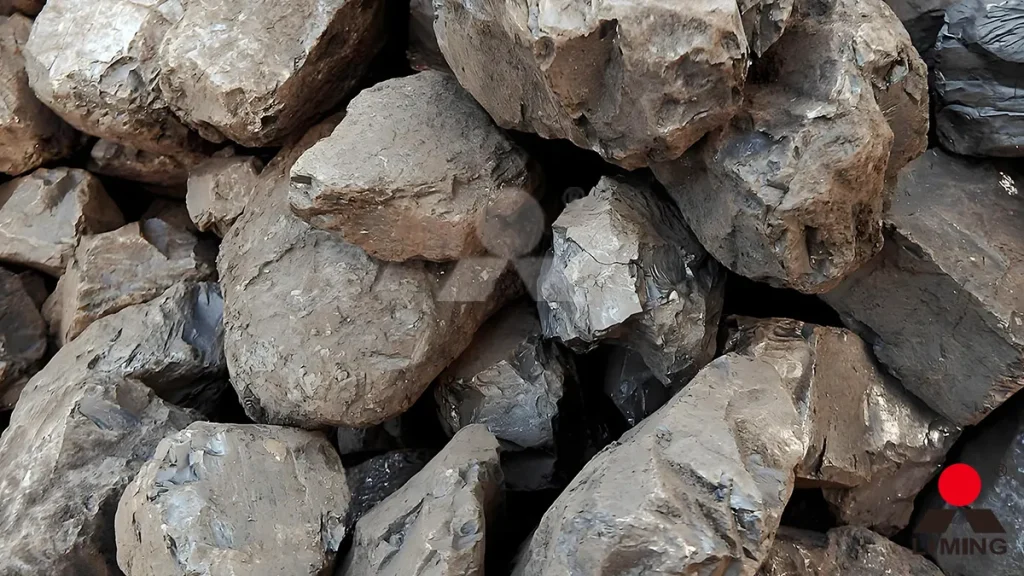
I. Uncovering the “Hardness Truth” of Copper Ore
Many novice plant operators hear “copper ore” and automatically assume the entire rock mass is brutally hard. In metallurgical reality, chalcopyrite only registers a 3.5 to 4.0 on the Mohs hardness scale. The true mechanical enemies in the crushing chamber are the gangue minerals: quartz (Mohs hardness 7) and iron pyrite (Mohs hardness 6 to 6.5), both of which possess an extremely high abrasion index.
Because of this gangue, process engineers strictly classify copper ore as a medium-high hardness material. Impact crushers and hammer crushers must be entirely avoided; their blow bars will be consumed at a financially disastrous rate. The Cone Crusher must be prioritized. Operating on the lamination crushing principle, rocks are forced to squeeze and crush against each other inside the cavity. This mechanism perfectly adapts to high-hardness materials, yielding a uniform, highly cubic particle shape while keeping the consumption of expensive manganese liners strictly controllable.
II. The Mainstream Flowsheet: Three-Stage Closed-Circuit Crushing
Modern copper concentrator plants universally pursue the absolute metallurgical doctrine of “more crushing, less grinding.” The electrical power consumed during the crushing stage is typically only one-third to one-fifth of the power consumed by the grinding mills. Reducing the ball mill feed size from 15 millimeters down to 10 millimeters can successfully slash grinding electricity costs by 20% to 30%.
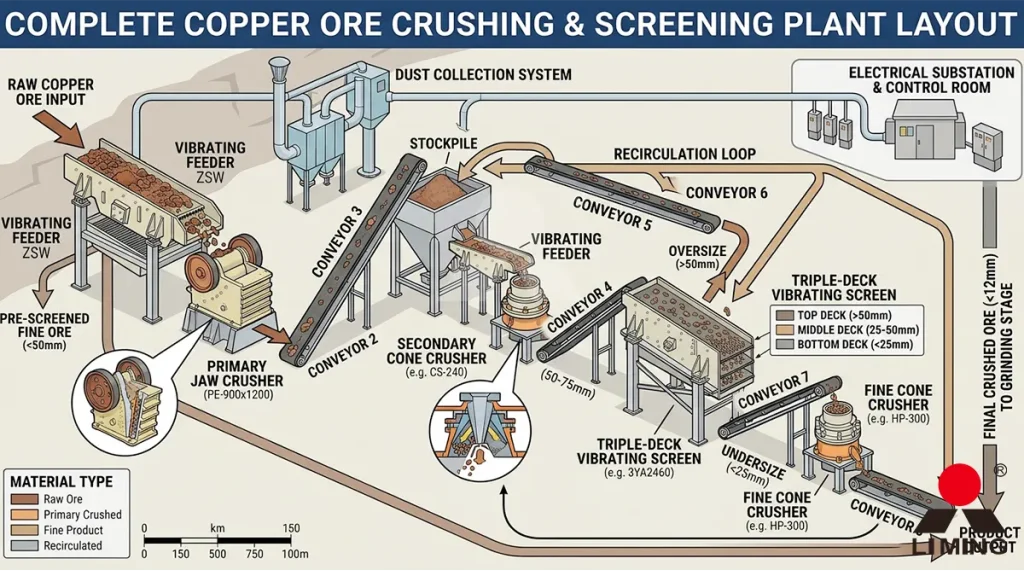
The standard, highly efficient process flow is the Three-Stage Closed-Circuit configuration:
- Primary Coarse Crushing: The Jaw Crusher is deployed to reduce large run-of-mine boulders down to below 150 millimeters.
- Secondary Medium Crushing: The Single-Cylinder Hydraulic Cone Crusher takes over, forcefully pulling the particle size down to approximately 40 millimeters.
- Tertiary Fine Crushing: The Multi-Cylinder Hydraulic Cone Crusher operates in a strict closed-circuit loop with a vibrating screen, guaranteeing a steady supply of qualified feed (strictly below 13 millimeters) to the ball mills.
By installing a vibrating screen in the tertiary stage, any oversized rock that fails to pass the mesh is automatically returned to the multi-cylinder cone for re-crushing, guaranteeing the ball mills are fed with perfectly uniform, fine material.
III. A Four-Step Engineering Methodology for Selection
Step One: Lock in the Crushing Stage. For copper ore, the secondary (medium) crushing stage predominantly utilizes single-cylinder hydraulic cone crushers, while the tertiary (fine) stage heavily relies on multi-cylinder hydraulic cone crushers.
Step Two: Size the Model Based on Capacity. The secondary crusher must be sized with a capacity rating approximately 1.2 times the primary feed volume. Because the tertiary fine crushing stage operates in a closed-circuit loop, it must process the new incoming feed plus the recirculating load returning from the screen. Therefore, the tertiary cone crusher must possess a volumetric throughput roughly 1.3 to 1.5 times the primary feed volume, requiring a 30% to 50% capacity safety margin.
Step Three: Match the Cavity Profile. A single machine model offers multiple interchangeable cavity profiles. For the copper ore fine crushing stage, the “Fine Crushing Cavity” must be prioritized. If the upstream feed size fluctuates wildly, engineers may temporarily widen the discharge opening to prevent mechanical blockages.
Step Four: Configure Automation Protocols. In large-scale metallic mines, equipping the plant with an automated centralized control system is mandatory. This system continuously monitors real-time motor load, oil temperature, and hydraulic pressure, executing automatic tramp iron release and overload protection protocols instantly.
IV. Deploying the HST and HPT Cone Crushers
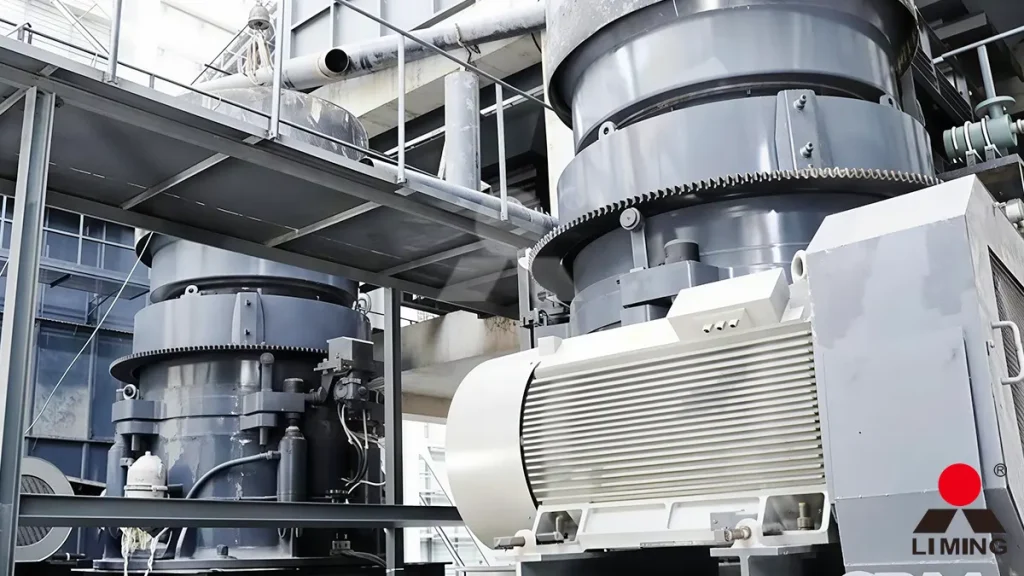
Taking the HST Series Single-Cylinder Hydraulic Cone Crusher from Liming Heavy Industry as the benchmark, the machine excels in the secondary (medium) crushing stage. The HST series features a massive structural design, convenient hydraulic calibration, and highly sensitive tramp iron protection, ensuring absolute stability under heavy continuous loads.
For the tertiary (fine) crushing stage, engineers deploy the HPT Series Multi-Cylinder Hydraulic Cone Crusher. Utilizing an optimized fine crushing cavity, the HPT utilizes high-speed eccentric rotation and intense lamination crushing. This produces a perfectly cubic particle shape with minimal flat or elongated (needle-like) pieces, delivering an incredibly high yield of sub-13 millimeter mill feed.
Engineering Note: Standard capacity tables reflect open-circuit, ideal operating conditions. In real-world mining, actual throughput is heavily discounted by rock hardness, moisture content, and the uniformity of the feed. Both the HST and HPT series are specifically engineered to withstand the extreme abrasive wear inherent in iron ore, copper ore, and other metallic mining operations.
V. Common Pitfalls in Copper Ore Project Selection
- Focusing Solely on the Purchase Price: Ignoring the long-term cost of consumable manganese liners and electrical power consumption is a fatal error. While advanced hydraulic cone crushers require a higher initial capital investment, their extended liner lifespan and vastly superior energy efficiency per ton yield a much lower total lifecycle operating cost.
- Misapplying Medium Crushers as Fine Crushers: Forcing a secondary cone crusher to act as a tertiary fine crusher by blindly tightening the discharge opening to its absolute minimum causes catastrophic problems. This practice chokes the throughput capacity, generates excessive flat and elongated particles, and results in severe over-pulverization.
- Neglecting Feed Uniformity: A cone crusher must receive a uniform, 360-degree continuous feed to function properly. Eccentric loading (where rocks pour onto only one side of the chamber) accelerates unilateral liner wear, destroying the mechanical balance of the main shaft and drastically shortening the machine’s service life.
- Failing to Engineer Capacity Margins: Surging feed volumes, encountering harder ore veins, and gradual liner wear will all cause the actual plant capacity to shrink over time. Engineers must rigorously calculate a 10% to 20% capacity redundancy during the initial selection phase to guarantee long-term production targets.
The fundamental essence of copper ore crushing equipment selection is matching the discharge size, volumetric capacity, and electrical energy consumption perfectly to the demands of the downstream grinding circuit. By deploying the correct, heavy-duty Cone Crushers from Liming Heavy Industry, plant operators massively relieve the burden on the ball mills, securing a dramatic reduction in both electricity consumption and steel grinding ball depletion.

