


HPT Cone Crusher Sizing For 200mm Feed And 300 TPH Capacity
Configuring a multi-cylinder hydraulic cone crusher requires balancing maximum feed size against targeted hourly capacity. This engineering guide details the HPT cone crusher sizing for a 200mm feed and 300 Tons Per Hour (TPH) capacity requirement. Written by a senior process engineer, the article explains why strict safety margins eliminate smaller models like the HPT300, and why the HPT400 configured with a coarse cavity is the only machine capable of providing a 15% feed margin while safely guaranteeing the 300 TPH output.
An incoming feed size of 200 millimeters and a target capacity of 300 tons per hour (TPH) represent the two most common mechanical constraints placed on multi-cylinder hydraulic cone crushers in medium-to-small aggregate production lines. According to the current technical parameters of the HPT Series Multi-Cylinder Hydraulic Cone Crusher lineup from Liming Heavy Industry, there are eight specific configurations that feature a tight-side feed opening of 200mm or greater, with processing capacities spanning from 240 to 1000 TPH. However, when we apply strict engineering safety margins into the calculation, only one specific configuration perfectly satisfies both criteria simultaneously.
I. How to Calculate Engineering Safety Margins
The tight-side feed opening dimension marks the absolute maximum allowable incoming particle size; it is not the recommended continuous feed size. Experienced plant engineers enforce two non-negotiable safety rules: first, the maximum discharge particle size from the upstream equipment must be smaller than the maximum allowable feed size of the cone crusher, retaining a safety margin of 15% to 20%. Second, the target processing capacity must also retain a 15% to 20% margin to prevent motor stalling during feed surges.
- For a 200mm Incoming Feed: Retaining a 15% safety margin dictates that the tight-side feed opening must be no smaller than 235mm; retaining a 20% margin requires an opening no smaller than 250mm.
- For a 300 TPH Target Capacity: Retaining a 15% safety margin requires the nominal nameplate capacity to reach at least 345 TPH; retaining a 20% margin requires coverage up to 360 TPH.
II. Step-by-Step Model Verification
Let us cross-reference these margins against the specific HPT models operating near this capacity tier to illuminate the mechanical discrepancy.
| Machine Model & Cavity Type | Feed Opening (Tight Side, mm) | 200mm Feed Margin | Processing Capacity (t/h) | Covers 345 to 360 TPH? |
|---|---|---|---|---|
| HPT300 Coarse (C) | 210 | 5% | 190 to 380 | Yes, but feed margin is inadequate |
| HPT400 Medium (M) | 200 | 0% | 240 to 370 | Yes, but feed margin is inadequate |
| HPT400 Coarse (C) | 250 | 20% | 280 to 430 | Yes, fully covers both |
| HPT500 Medium (M) | 210 | 5% | 335 to 600 | Yes, but feed margin is inadequate |
| HPT500 Coarse (C) | 286 | 30% | 395 to 680 | No, capacity is too large |
Out of these five configurations, only the HPT400 Coarse Cavity passes both engineering checkpoints. The capacities of the HPT300 Coarse and HPT500 Medium can both cover the 300 TPH demand, but their tight-side feed opening is only 210mm. Feeding 200mm rock into a 210mm opening provides a razor-thin 5% margin; in actual production, the moment the upstream jaw crusher’s liners wear down slightly, the feed will instantly become oversized and jam the cone cavity. The HPT400 Medium Cavity has a feed opening of exactly 200mm, meaning the margin is zero—which is equivalent to running the machine constantly on the absolute brink of failure. The HPT500 Coarse Cavity offers the most abundant feed margin, but its processing capacity starts at 395 TPH, making the machine physically too large and economically wasteful for a 300 TPH target.
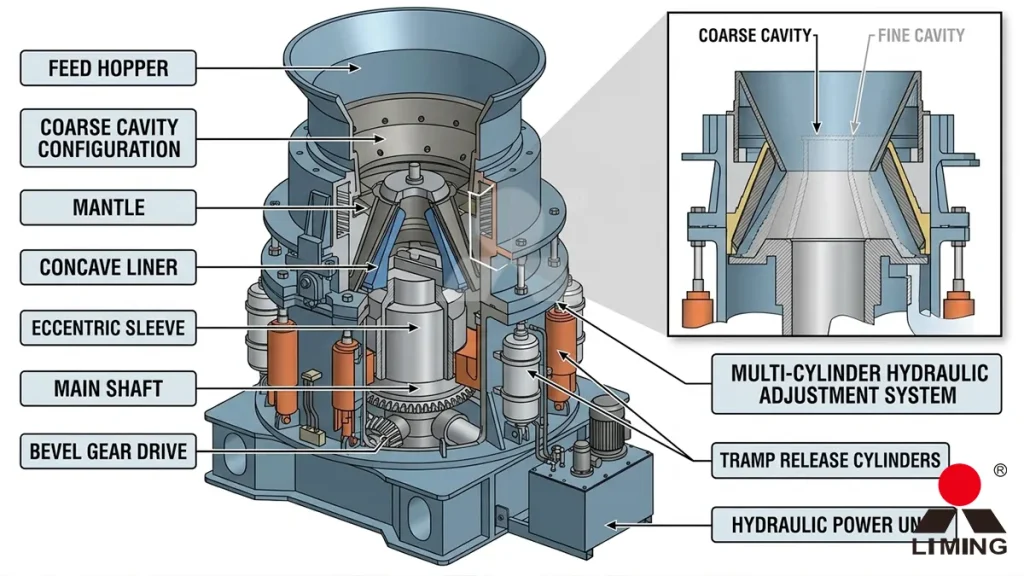
III. The Positioning of the HPT400 Coarse Cavity
The HPT400 Coarse Cavity features a tight-side feed opening of 250mm, a minimum discharge opening of 25mm, a processing capacity ranging from 280 to 430 TPH, and a motor power of 315 kW. Relative to a 200mm feed, the 250mm opening provides a perfect 20% safety margin. The 300 TPH target lands comfortably in the lower-middle section of the 280 to 430 TPH envelope, leaving an upward capacity redundancy of 130 TPH to handle feed surges.
Alternatively, if the upstream primary crusher can be adjusted to strictly throttle the incoming feed size down to below 178 millimeters (providing a 15% margin against a 210mm opening), the plant could be upgraded to the HPT500 Medium Cavity (335 to 600 TPH). This would provide massive capacity redundancy and a tighter minimum discharge opening of 22mm compared to the HPT400’s 25mm.
IV. Safety Margins Are Dictated by the Front-End Control
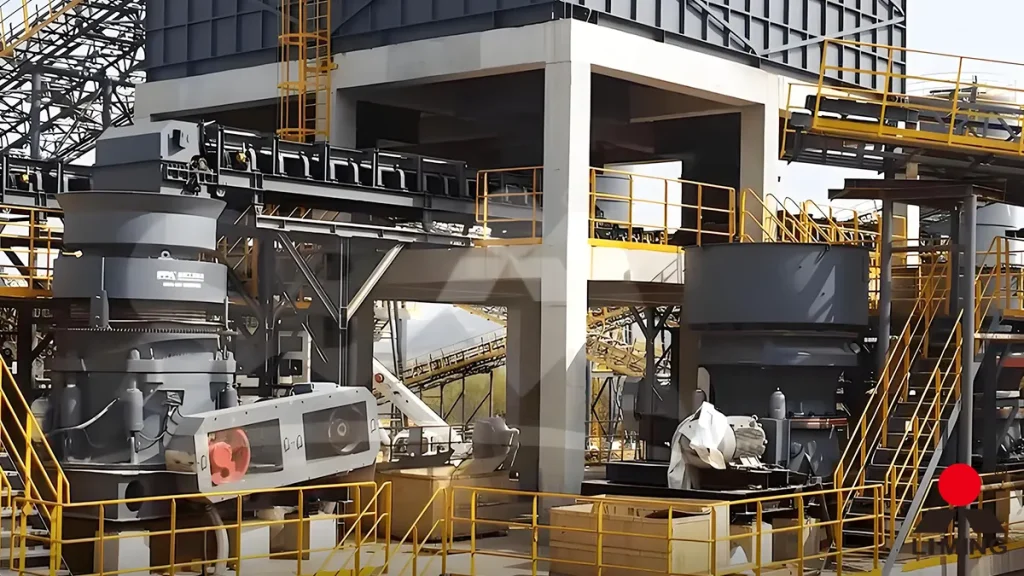
Consider a massive 2000 TPH tuff production line in Ningde, Fujian. The upstream section explicitly restricted the feed entering the multi-cylinder cones to strictly below 250mm, resulting in a finished aggregate flakiness index below 5%. This facility proves the operational reality: safety margins are not just numbers calculated on paper; they are actively enforced by setting the upstream discharge opening and utilizing vigorous pre-screening.
In another commercial project in Fuyang, Hangzhou, an HPT300 was deployed for high-grade aggregate production at 200 TPH. The HPT300 Coarse Cavity has a tight-side feed opening of 210mm. Applying a 15% margin yields a maximum feed limit of 178mm. This machine operated flawlessly at the lower limit of its 190 to 380 TPH envelope, but only because the incoming feed particle size was ruthlessly defended at 178mm.
V. Application Boundaries and Calibration Conditions
All printed processing capacity figures carry specific calibration conditions: the material moisture content must not exceed 4%; it must contain absolutely no sticky clay; fine particles must represent less than 10% of the feed and be distributed evenly 360 degrees around the chamber; the loose bulk density is assumed at 1.6 tons per cubic meter; and the compressive strength must be exactly 150 megapascals (MPa).
In real-world production on hard rock, the actual throughput will fall below the nameplate capacity range. The exact derating factor is determined by the measured compressive strength and the feed gradation—you cannot blindly apply a flat percentage discount. Furthermore, production capacity during closed-circuit operation is inherently slightly lower than open-circuit operation.
If the raw material contains excessive moisture or mud, it must be aggressively pre-screened. Feeding muddy material into a cone crushing cavity will cause it to pack tightly, completely destroying both the capacity and the discharge particle shape. By partnering with Liming Heavy Industry, aggregate producers guarantee that their secondary crushing circuits are sized with absolute engineering precision to minimize long-term operating expenses.

