


What Size Cone Crusher For 500 TPH Plant Model Recommendations?
Selecting the correct cone crusher size for a 500 Tons Per Hour (TPH) production line is a critical engineering decision that balances initial capital expenditure against daily operating expenses. Sizing a machine too small bottlenecks production, while oversizing wastes power. Written by a senior process engineer, this technical guide explains how to select between Liming Heavy Industry’s CS Spring, HST Single-Cylinder, and HPT Multi-Cylinder Cone Crushers based on rock hardness, detailing the multi-stage closed-circuit flowsheet required for continuous 500 TPH production.
Clients frequently ask me the exact same question during project feasibility consultations: “I am building a 500 tons per hour aggregate production line; what size cone crusher do I actually need?”
To be completely honest, 500 tons per hour (TPH) is a pivotal and somewhat tricky capacity tier. It is certainly not a small-scale operation, yet it does not quite reach the scale of an industrial mega-quarry. Many plant operators stumble at this exact threshold. Some take the shortcut of blindly copying a competitor’s flowsheet, only to discover too late that their rock is far harder. This results in rapid wear part destruction and unacceptable aggregate particle shapes. Others take the opposite extreme, massively oversizing their machinery. While this guarantees abundant capacity, it permanently wastes hundreds of thousands of dollars in unnecessary capital expenditure and excessive monthly electrical power bills.
In this engineering guide, we will break down the precise sizing logic so you can select the perfect cone crusher configuration for your 500 TPH facility.
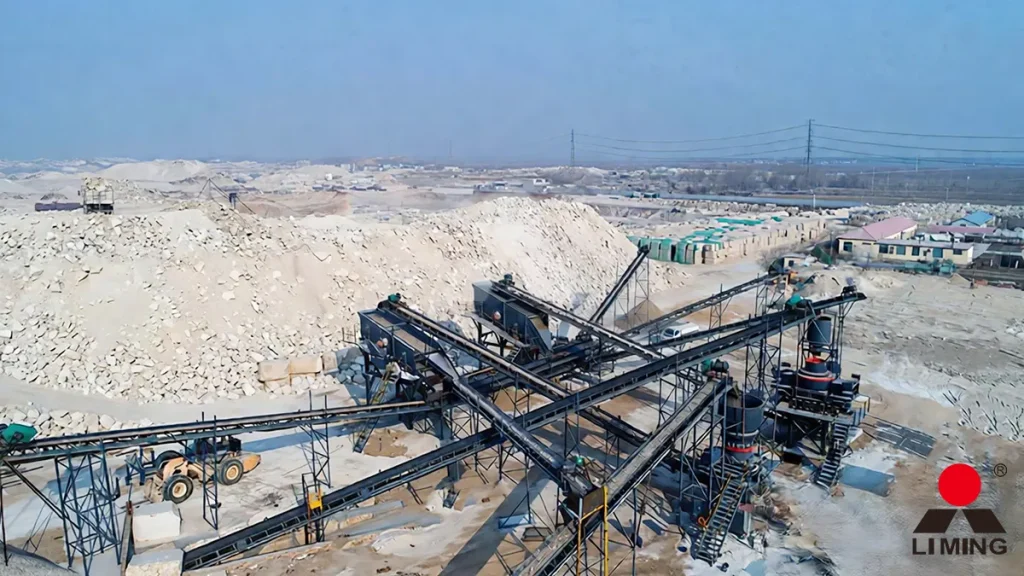
I. Evaluate Material Hardness Before Discussing Crusher Sizing
When selecting a cone crusher for a 500 TPH line, the very first step is not flipping through equipment catalogs. The first task is determining the compressive strength, abrasiveness, and exact geological classification of the blasted rock.
For medium-hard materials such as limestone, sandstone, and bluestone, compressive strengths typically range between 80 and 120 megapascals (MPa). For these softer rocks, an advanced spring cone crusher is entirely sufficient. It provides high cost-effectiveness, simple mechanical maintenance, and exceptional operational peace of mind.
However, if your quarry contains hard, highly abrasive rocks like granite, basalt, or river pebbles, a hydraulic cone crusher is mandatory. Beyond delivering superior lamination crushing, modern hydraulic systems provide constant crushing force, highly sensitive tramp iron protection, automated closed-side setting adjustments, and active liner wear compensation. In hard-rock conditions, these hydraulic advantages are magnified exponentially—ensuring highly stable finished particle shapes, predictable wear part replacement cycles, and a drastically reduced risk of unscheduled downtime.
Once the material characteristics are verified in the laboratory, selecting the correct machine model becomes straightforward.
II. Recommended Cone Crusher Models for 500 TPH Lines
Drawing upon extensive project execution experience from Liming Heavy Industry, commercial 500 TPH plants typically deploy one of two proven machinery combinations depending on rock hardness.
1. Configuration for Medium-Hard Materials (Limestone, Sandstone)
For processing medium-hard rock, a classic split-load flowsheet is highly reliable: the secondary stage utilizes a single high-capacity CS Series Spring Cone Crusher (such as the CSB240 model, processing up to 635 tons per hour), while the tertiary fine-crushing stage deploys two smaller spring cone crushers (such as two CSD160 units) operating in parallel to distribute the fine-crushing load.
This multi-unit configuration has run with exceptional stability across numerous commercial projects, effortlessly sustaining a continuous output of 500 tons per hour. Alternatively, for operations prioritizing a compact footprint, deploying a single large-capacity HPT500 Multi-Cylinder Hydraulic Cone Crusher (handling up to 790 tons per hour) can achieve the required throughput in a single machine.
2. Configuration for High-Hardness Materials (Granite, Basalt)
If the rock is hard and abrasive, or if local building codes enforce strict cubic aggregate shape standards, the secondary stage should utilize the HST Series Single-Cylinder Hydraulic Cone Crusher (such as the HST315). The HST series delivers massive structural strength, convenient hydraulic calibration, and highly dependable tramp iron protection. The tertiary fine-crushing and shaping stage is then assigned to an HPT Series Multi-Cylinder Hydraulic Cone Crusher (such as the HPT300 or HPT400) to force the material into a perfectly cubic particle shape with minimal needle-like content.
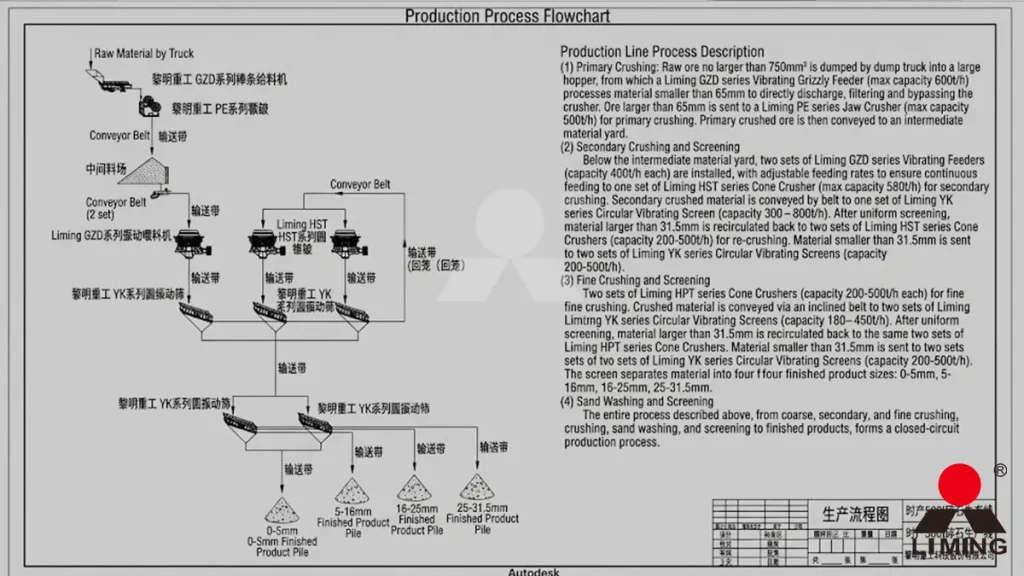
III. From Standalone Machine to Complete Production Line Synchronization
Selecting the individual cone crusher model is only the first step. The true engineering key to a successful 500 TPH plant lies in the seamless mechanical transition between the primary, secondary, and screening stages.
In a standard, highly efficient 500 TPH flowsheet, the primary reduction is assigned to a heavy-duty PE Series Jaw Crusher (such as the PE-900×1200 or PE-1000×1200), which reduces run-of-mine boulders down to below 200 millimeters. This material is conveyed to an intermediate surge pile before being fed evenly into the secondary cone crusher.
The material discharged from the cone crusher passes over a YKN Series Circular Vibrating Screen (such as the 3YKN2460 or 3YKN3072) or an S5X Series Vibrating Screen for classification. Qualified aggregate is transferred directly to the commercial product stockpiles. Any oversized material that fails to pass the screen mesh is automatically returned to the tertiary cone crushers for re-crushing in a strict closed-circuit loop.
In a recent commercial sandstone project engineered by Liming Heavy Industry, this exact configuration—a PE Jaw Crusher feeding secondary and tertiary cone crushers in closed circuit with heavy-duty circular vibrating screens—maintained a steady, continuous output of 500 tons per hour, proving the immense reliability of synchronized plant design.
Conclusion
Ultimately, when engineering a 500 TPH aggregate production line, there is no generic “off-the-shelf” answer for cone crusher sizing. There is only the configuration that matches your specific raw rock properties, finished product requirements, and capital budget.
Liming Heavy Industry delivers world-class comminution technology and turnkey Engineering, Procurement, and Construction (EPC) services. If you are preparing to commission a new 500 TPH line or upgrade an existing facility, do not guess on machine sizing. Contact our engineering team today to conduct laboratory rock tests, receive precise capacity calculations, and obtain a customized, direct-from-factory equipment proposal.

