


Sand Production Machine Selection
Selecting the correct manufactured sand machine requires analyzing raw rock mineralogy, feed size, target fineness modulus, and particle shape specifications. Written by an aggregate systems architect, this engineering guide evaluates sand production machine selection parameters across vertical shaft impactors, cone crushers, and sand washers. It features specific machine models, including the VSI6X sand maker and HPT cone crusher, to optimize concrete sand quality while controlling operating expenses.
In the modern aggregate industry, the rapid depletion of natural river sand reserves has forced ready-mix concrete suppliers and infrastructure contractors to rely almost entirely on manufactured sand. However, transitioning from natural sand to crushed sand is not as simple as putting a fine screen after a secondary crusher. Concrete workability, compressive strength, and cement consumption depend heavily on particle shape, gradation curves, and fineness modulus.
When clients consult me for plant design, they often expect a simple equipment recommendation. My answer is always that machine selection is the final step of a complex process analysis. The correct selection depends on raw rock mineralogy, silica content, Bond Work Index hardness, moisture, and the exact proportion of micro-dust permitted by regional building codes.
In this technical guide, I will outline the systems engineering approach to sand production machine selection, evaluating crushing mechanics, machine configurations, and flowsheet integration to ensure your plant achieves maximum profitability and product quality.
Understanding Comminution Mechanics: Rock-on-Rock vs. Rock-on-Anvil
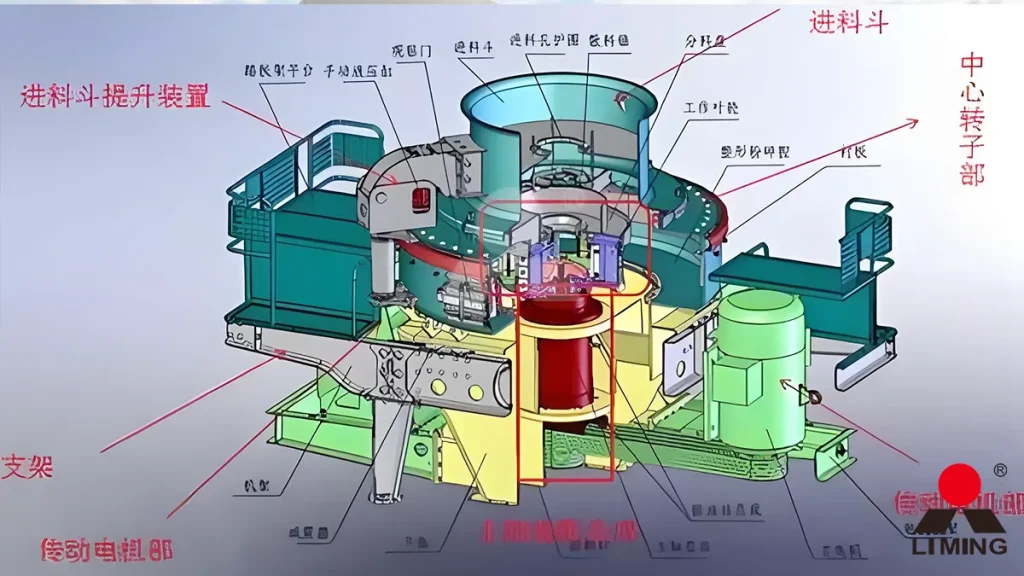
To select the right manufactured sand machine, you must first understand the fundamental crushing principles inside the rotor chamber. Vertical Shaft Impactors (VSIs) are the undisputed industry standard for fine sand production and aggregate shaping, but they operate on two distinct mechanical setups.
The first setup is the “rock-on-rock” configuration. In this design, raw rock is accelerated through a central rotor at velocities exceeding 70 to 80 meters per second. The rock is launched into a crushing chamber lined with a dead bed of crushed stone. Stone collides with stone. This intense mid-air collision shatters the rock along its natural mineral cleavage lines, producing an exceptionally cubic particle shape with zero internal micro-fissures. Because stone strikes stone, steel liner wear is reduced to an absolute minimum, making rock-on-rock the mandatory choice for highly abrasive feed materials like quartz, granite, and river pebbles.
The second setup is the “rock-on-anvil” configuration. Instead of striking a bed of stone, the accelerated rock impacts heavy alloy anvil plates installed around the chamber perimeter. This delivers a much higher reduction ratio and produces a finer gradation of sand in a single pass. However, anvil wear increases exponentially when processing high-silica stone. Rock-on-anvil is strictly recommended for non-abrasive or medium-hard rocks, such as limestone or dolomite, where wear part costs remain manageable.
Core Machine Categories for Manufactured Sand Production
Depending on your circuit position—whether primary fine reduction, tertiary shaping, or ultra-fine sand generation—different equipment types must be integrated into the system.
1. High-Efficiency Vertical Shaft Impactors (VSI Series)
Vertical shaft impactors represent the primary shaping and fine sand machinery in modern plants. Advanced units like the VSI6X1040 Sand Maker feature a four-opening rotor design that optimizes material throughput and fluid dynamics inside the chamber compared to older three-opening designs. Equipped with a dual-motor drive system, heavy-duty bearings, and a hydraulic lifting cover for rapid inspection, machines in the VSI6X and VSI5X series allow operators to fine-tune impeller speed to control the fineness modulus of the output sand within the strict 2.6 to 3.0 range required for concrete.
2. Hydraulic Cone Crushers for Fine Circuit Preparation
When processing extremely hard rocks like basalt or river gravel, feeding 40mm stone directly into a VSI can cause excessive rotor wear and high electrical power draw. In high-capacity hard rock plants, engineers install a multi-cylinder hydraulic cone crusher, such as the HPT300 Cone Crusher, upstream of the sand maker. The cone crusher uses lamination crushing to reduce the 40mm stone down to a tight 0-10mm or 0-15mm super-fine feed size. This pre-reduction dramatically increases the crushing efficiency and rotor tip lifespan of the downstream VSI sand maker.
3. Heavy Impactors for Soft Rock Processing
For large-scale limestone processing plants, fine crushing and initial sand generation can be achieved using secondary impact crushers like the CI5X1315 Impact Crusher. While an impactor cannot match a VSI in micro-shaping, its large reduction ratio allows it to handle larger feed sizes while producing a high percentage of fine stone dust, which can then be classified and screened into commercial construction sand.
4. Wet Washing vs. Dry Air Classification Systems
Once sand is produced, it must be classified to control stone dust content (particles smaller than 75 microns). In wet processing plants, material passes through a wheel sand washer like the XSD3016 Sand Washer, where water washes away excessive silt and clay. In arid regions or high-capacity dry plants, an air classifier uses controlled airflow and centrifugal force to pull out fine dust without consuming a single gallon of water.
Engineering Decision Matrix for Sand Machine Selection
To streamline the selection process, I have compiled an engineering decision matrix that maps raw material properties and application targets to specific machine configurations and Liming Heavy Industry equipment models.
| Raw Material & Geology | Feed Size Range | Abrasion & Silica Level | Recommended Machine Configuration | Target Machine Model |
|---|---|---|---|---|
| River Pebbles & Granite | 0 – 35 mm | High (SiO2 > 65%) | Rock-on-Rock VSI with pre-reduction Cone Crusher | HPT300 Cone + VSI6X1150 Sand Maker |
| Hard Basalt & Quartzite | 0 – 25 mm | Extreme (High Hardness) | High-speed Rock-on-Rock VSI + Heavy Duty Classifier | VSI6X1040 Sand Maker + S5X2460-3 Screen |
| Limestone & Dolomite | 0 – 50 mm | Low to Medium (Non-Abrasive) | Rock-on-Anvil VSI or Secondary Heavy Impactor | CI5X1315 Impactor / VSI5X9532 Sand Maker |
| Tailings & Mine Waste | 0 – 10 mm | Variable (Ultra-Fine Feed) | High-RPM Shaping VSI + Wheel Sand Washer | VSI6X9026 Sand Maker + XSD3016 Washer |
Plant Flowsheet Integration and Screening Efficiency
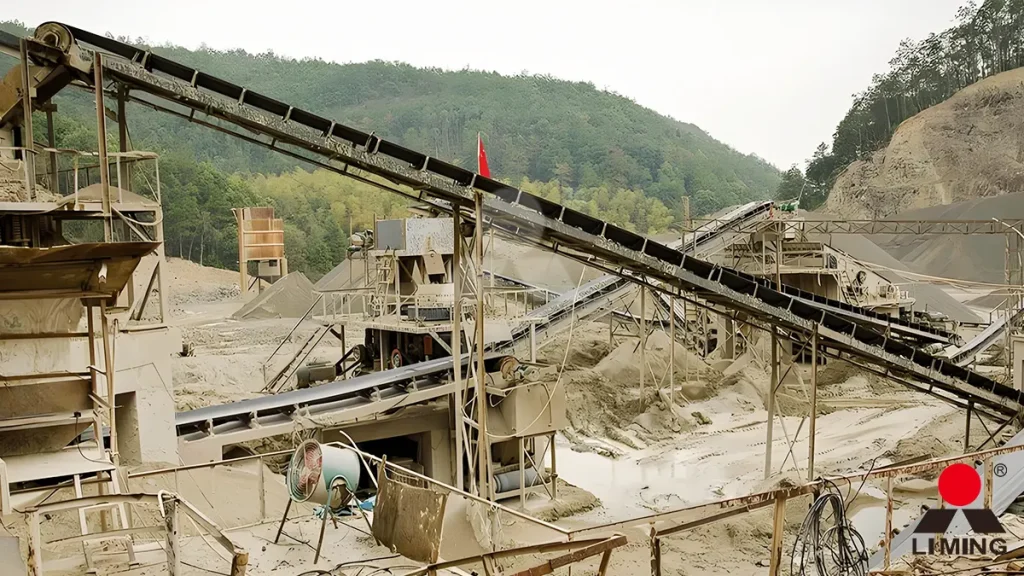
A sand production machine cannot operate in isolation. Its throughput and product quality depend directly on the closed-circuit screening system. If your screening capacity is inadequate, fine material returns to the sand maker repeatedly, causing over-grinding, generating excessive unwanted slimes, and wasting electrical power.
In a standard 200 ton per hour manufactured sand plant, the VSI sand maker operates in a closed loop with a high-frequency vibrating screen, such as the S5X2460-3 Vibrating Screen. The screen deck must be fitted with anti-blinding polyurethane or high-tensile woven wire mesh to handle fine separations at 2.3mm, 4.75mm, and 9.5mm. Oversized stone (+4.75mm) is recirculated back to the VSI rotor, while undersized material passes to the washing or dry classification unit.
Why Turnkey Systems Engineering Superior to Standalone Equipment
Throughout my career, I have seen plant owners buy high-end sand makers only to achieve disappointing results because the upstream crusher produced an erratic feed size, or the downstream screens were improperly inclined. Machine selection must be viewed as part of a complete comminution ecosystem.
At Liming Heavy Industry, we approach manufactured sand production from a complete systems engineering perspective. We perform comprehensive geological lab tests on your rock samples to determine Bond Work Index hardness and abrasion coefficients before drafting a flowsheet. From heavy machinery manufacturing to civil foundation layout design, automated PLC control integration, and site commissioning, our engineering team delivers turnkey systems that minimize capital expenditure while guaranteeing long-term operational stability.
Frequently Asked Questions (FAQ)
Below are technical answers to common process engineering questions regarding sand production machine selection.
1. What is fineness modulus, and why is it crucial for manufactured sand?
Fineness modulus is an empirical factor obtained by adding the total percentages of material retained on a standard series of sieves and dividing by 100. It measures the coarseness or fineness of the sand. A fineness modulus between 2.6 and 3.0 is required for high-strength concrete workability.
2. What is the main difference between VSI5X and VSI6X sand makers?
The VSI6X series features an upgraded four-opening rotor design compared to the older three-opening structure of the VSI5X. This increases material throughput by 10% to 20%, improves aerodynamic efficiency, and reduces wear part costs per ton of produced sand.
3. How do I control excessive stone dust (<75 microns) in dry sand production?
Stone dust is controlled by integrating an air classifier downstream of the VSI sand maker. By adjusting fan speed and internal baffle angles, the air classifier pulls out fine micro-dust using airflow, maintaining dust levels within building code limits without water.
4. Why should I install a cone crusher before my VSI sand maker?
Installing a hydraulic cone crusher like the HPT300 upstream reduces coarse rock (e.g., 40mm) down to super-fine feed (under 10-15mm). This feed pre-conditioning doubles VSI sand output efficiency and reduces VSI rotor tip wear when processing abrasive rock.
5. When should I choose wet sand washing over dry classification?
Choose wet sand washing with an XSD wheel washer if your raw rock contains high clay or organic silt content that cannot be separated by air. Choose dry classification if you operate in freezing climates, arid regions, or must eliminate wastewater treatment ponds.
6. What causes rapid wear on VSI rotor tips?
Rapid rotor tip wear is caused by processing high-silica rock in a rock-on-anvil setup, running the VSI with an inconsistent or under-capacity feed rate, or feeding rock larger than the rotor’s maximum inlet opening size.
7. What is the optimal feed moisture content for a VSI sand maker?
Optimal feed moisture for dry screening and VSI sand making should be under 2% to 3%. Moisture above 5% causes material to stick inside the rotor, reduces impact velocity, and blinds vibrating screen meshes.
8. Can a jaw crusher produce manufactured concrete sand directly?
No. A jaw crusher produces coarse, flaky aggregate with high internal micro-fissures and irregular gradation. It cannot produce the cubicity, micro-fines balance, or fineness modulus required for concrete sand without tertiary VSI processing.
9. What is the power consumption difference between wet and dry sand plants?
Dry sand plants generally consume 15% to 25% less overall power because they eliminate high-kw slurry pumps, freshwater intake pumps, and filter press dewatering equipment required by wet processing circuits.
10. What turnkey EPC services does Liming Heavy Industry offer for sand plants?
Liming Heavy Industry provides complete turnkey services including geological ore testing, flowsheet design, equipment manufacturing, civil layout planning, automated control system integration, installation supervision, and full site commissioning.
Conclusion
Successful sand production machine selection is the cornerstone of a profitable aggregate manufacturing enterprise. As detailed in this guide, selecting the right machinery requires an engineering evaluation of raw rock hardness, silica content, rotor chamber mechanics, and closed-circuit screening design.
Matching your geology to the correct combination of pre-reduction cone crushers, VSI sand makers, and classifiers prevents severe rotor tip wear, reduces operating expenses, and ensures your manufactured sand consistently meets premium concrete specifications. Contact the systems engineering team at Liming Heavy Industry today to analyze your rock samples and design a custom sand production line.

