


Tunisia 200 To 300 TPH Marble Sand Making Plant
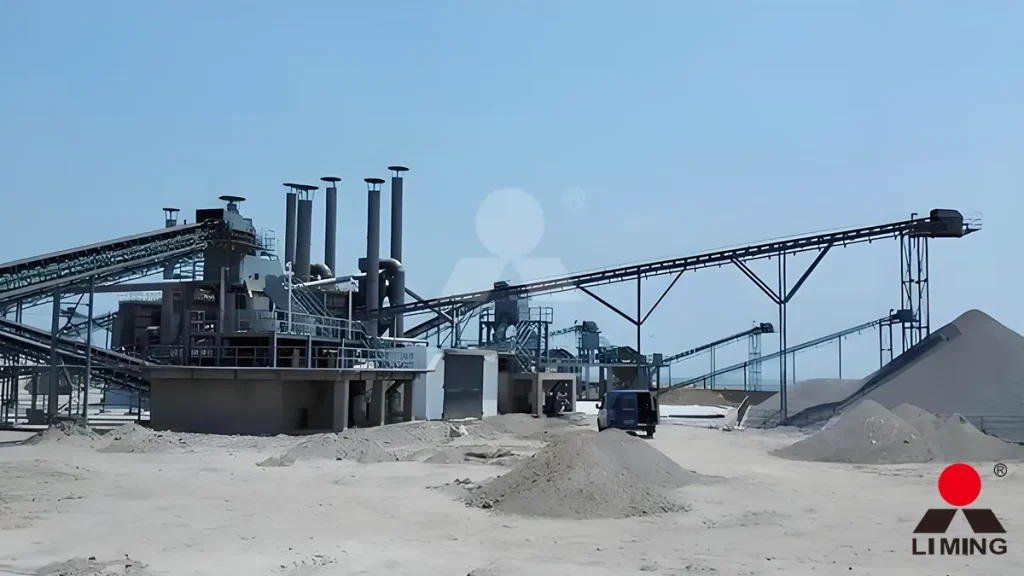
Producing 1mm and 2mm fine marble sand requires extreme precision to control stone powder generation and prevent screen blinding. This engineering case study explores a 200 to 300 Tons Per Hour (TPH) marble sand making plant deployed in Tunisia by Liming Heavy Industry. Written by the lead process engineer, the article details the equipment selection—featuring the PEW Jaw Crusher, VSI6X Sand Maker, and S5X Vibrating Screen—and shares frontline commissioning solutions to guarantee premium product quality and low daily operating expenses.
Last month, our engineering team dispatched a complete marble manufactured sand production line with a capacity of 200 to 300 tons per hour to a client in Tunisia. As the process engineer responsible for designing this specific circuit, I want to bypass the generic marketing brochures today and share the unvarnished, real-world details of this project. Specifically, we will discuss the severe challenges we faced regarding the client’s strict demand for 1-millimeter and 2-millimeter fine sand outputs, the pitfalls we navigated during equipment selection and on-site commissioning, and the final engineering configuration we locked in. Anyone experienced in mineral processing knows that crushing marble into sand behaves completely differently than processing standard river pebbles or granite. The technical nuances are substantial.
I. Why is Producing 1mm and 2mm Marble Sand a Technical Challenge?
Let us begin by analyzing the raw material. Marble does not possess top-tier hardness (typically registering between 3 and 4 on the Mohs hardness scale), but its crystalline structure is extremely brittle. The client did not provide an exact initial feed size, but based on local practices in Tunisia, the raw material primarily consists of marble offcuts and small waste blocks from dimension stone cutting operations. I engineered the primary intake for a maximum feed size of 400 millimeters.
The finished product requirements were uncompromising: strictly 1-millimeter and 2-millimeter fractions. This is essentially ultra-fine marble sand, highly sought after as a premium filler for artificial stone, terrazzo flooring, and architectural coatings.
Processing this ultra-fine sand presents two major operational pain points. First, because marble is so brittle, it shatters instantly upon impact, generating a massive volume of microscopic stone powder. If the equipment selection is incorrect, the yield rate of the actual usable sand will be disastrously low. Second, the client maintained strict requirements for particle shape; excessive flat or needle-like (flaky) shards would destroy the structural integrity of the downstream artificial stone products. Therefore, the core engineering challenge of this 200 to 300 TPH line was simultaneously controlling the stone powder content while guaranteeing perfect particle cubicity and stable throughput.
II. The Liming Heavy Industry Configuration Logic
While drafting the proposal, I spent considerable time evaluating these exact parameters. The final locked-in configuration consisted of a Vibrating Feeder, a PEW Series European Jaw Crusher, a VSI6X Series Vertical Shaft Impactor, an S5X Series Vibrating Screen, and a heavy-duty pulse-jet baghouse dust collection system.
1. Primary Coarse Crushing: PEW Series European Jaw Crusher
With an incoming feed size strictly under 400 millimeters, deploying the PEW Series European Jaw Crusher (specifically the PEW860 model) was the perfect choice. I selected the European-style jaw crusher primarily for its massive crushing ratio and incredibly stable intake within its V-shaped crushing cavity. Marble offcuts frequently have irregular, blocky shapes; the European jaw prevents these odd shapes from bridging or jamming the cavity. The processing capacity stabilizes easily above 200 tons per hour, providing a highly uniform, steady base feed for the downstream sand making equipment.
2. The Core Sand Making Stage: VSI6X Series Vertical Shaft Impactor
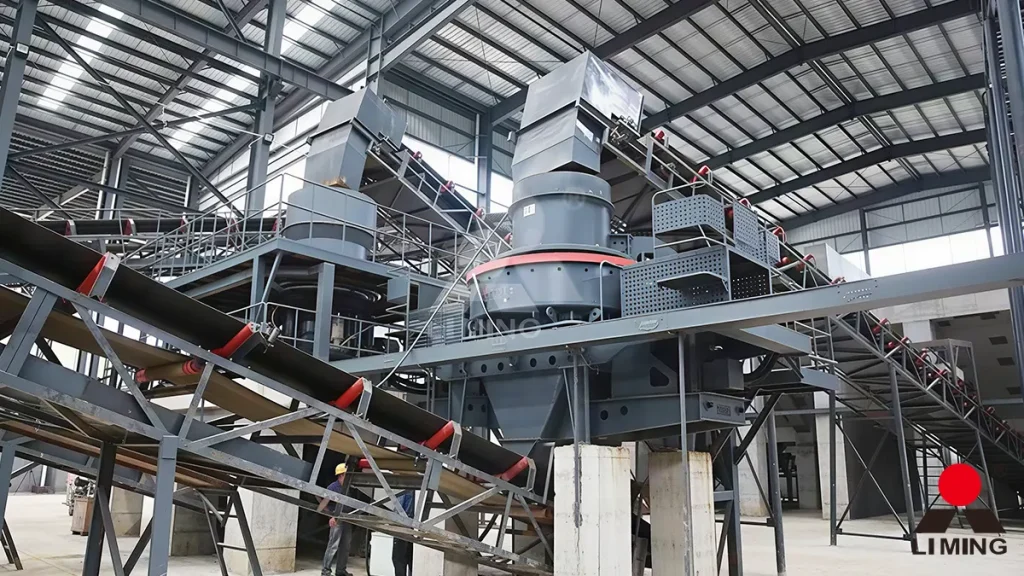
This machine is the absolute heart of the production line. To produce 1mm and 2mm sand, I flatly refused to deploy a cone crusher and instead utilized the VSI6X Series Sand Maker. Why? Because cone crushers inherently produce a higher percentage of flaky, needle-like particles, and brittle marble does not require heavy lamination compression.
The VSI6X utilizes a combination of “rock-on-rock” and “rock-on-anvil” cavity configurations. For a medium-hard, brittle material like marble, the “rock-on-rock” mode allows the stones to collide against each other in mid-air. This not only yields perfectly round, cubic sand particles but, most importantly, it drastically reduces the direct wear on the metal throw heads and perimeter guard plates, massively lowering the client’s long-term operating expenses. The VSI6X1150 model features a large rotor diameter and optimal tip speeds, comfortably enveloping the 200 to 300 TPH demand.
3. Screening and Powder Removal: S5X Series Vibrating Screen
When producing ultra-fine sand, the screening stage is the ultimate bottleneck. Screens handling 1mm and 2mm material are notoriously prone to severe blinding (hole blockages). We equipped the line with the S5X Series Vibrating Screen (specifically the S5X2160 model), which generates a massive dynamic excitation force and high vibration frequency.
Specifically addressing the high dust content of crushed marble, we custom-fitted the screen decks with highly elastic polyurethane anti-blinding mesh. The natural elasticity of the polyurethane allows the apertures to flex slightly during vibration, effectively ejecting wedged particles and ensuring the precise classification of the 1mm and 2mm finished products.
III. On-Site Commissioning Notes: Realities Not Found in Brochures
When the equipment arrived in Tunisia, mechanical installation was straightforward thanks to the modular design. However, the true test began during the live-load commissioning.
During dry runs, the equipment operated flawlessly. But the moment we introduced the raw marble feed, we hit a wall. Within 30 minutes, the 1-millimeter screen mesh became completely blinded by packed stone powder, and the total plant capacity instantly dropped by half.
I led the local crew in troubleshooting the circuit, and we immediately executed two mechanical adjustments. First, we micro-adjusted the inclination angle of the vibrating screen, dropping it from the standard 20 degrees down to 15 degrees. This slowed the material travel speed across the deck, drastically increasing the probability of fine particles passing through the mesh. Second, we fabricated and installed a simple dispersion cone directly at the feed inlet of the VSI6X sand maker. This forced the incoming marble to distribute perfectly evenly across the rotor, preventing localized overloading that was generating excess stone powder. Finally, we recalculated and increased the draft volume of the dust collection system by 15%.
After two days of relentless recalibration, the yield rate stabilized perfectly. The client was thoroughly impressed with the round, cubic shape of the 1mm and 2mm sand, and the stone powder content was firmly restricted within the required commercial limits.
IV. Conclusion
Engineering mining crushing and screening equipment is never as simple as bolting a few machines together. From the primary jaw crusher to the vertical shaft impactor and the vibrating screens, the parameter synchronization at every single stage directly dictates the ultimate financial profitability of the plant. This 200 to 300 TPH marble project in Tunisia serves as another testament to Liming Heavy Industry’s profound engineering accumulation in processing non-standard materials. If you have similar mineral processing requirements, or if you are uncertain about your production line configuration, we welcome you to contact the engineering team at Liming Heavy Industry. We speak exclusively through real-world operational data.

