


River Pebble Stone Crushing Plant
Deconstructing Silica Friction in River Pebble Stone Crushing Plant Deployments
The Impact Crusher Fallacy and Silica Hemorrhage
Forcing an impact crusher onto river pebbles destroys your expenditure per shift instantly.
I routinely audit and dismantle flowcharts drawn by amateur designers who attempt to apply medium-hard limestone logic to river pebbles. Utilizing a secondary impact crusher on feed with 85% silica content is an architectural fatal flaw. The abrasive friction of the pebbles sliding against the high-chrome blow bars will literally vaporize the steel alloy in under 48 hours.
You will spend more time swapping blow bars than producing aggregate.
To survive the 200MPa hardness, the secondary stage must rely on continuous annular compression, not direct kinetic impact against a rotor. A multi-cylinder HPT cone crusher is the only mathematically viable secondary option. It utilizes high-RPM lamination crushing, forcing the abrasive pebbles to grind against each other within a tightly calibrated 15mm Closed Side Setting (CSS), thereby protecting the manganese mantle from rapid degradation.
Grain Architecture and the VSI Mandate
While the HPT cone excels at compressive survival, it introduces a secondary geometric flaw. Although an HPT300 cone crusher survives the extreme hardness of river pebbles, its raw 0-20mm output inherently carries a 15-20% flakiness index. Because pebbles are naturally rounded, the compressive force of the cone often shears them into sharp, flat slivers.
Without further processing, this aggregate automatically fails high-grade commercial concrete compliance tests.
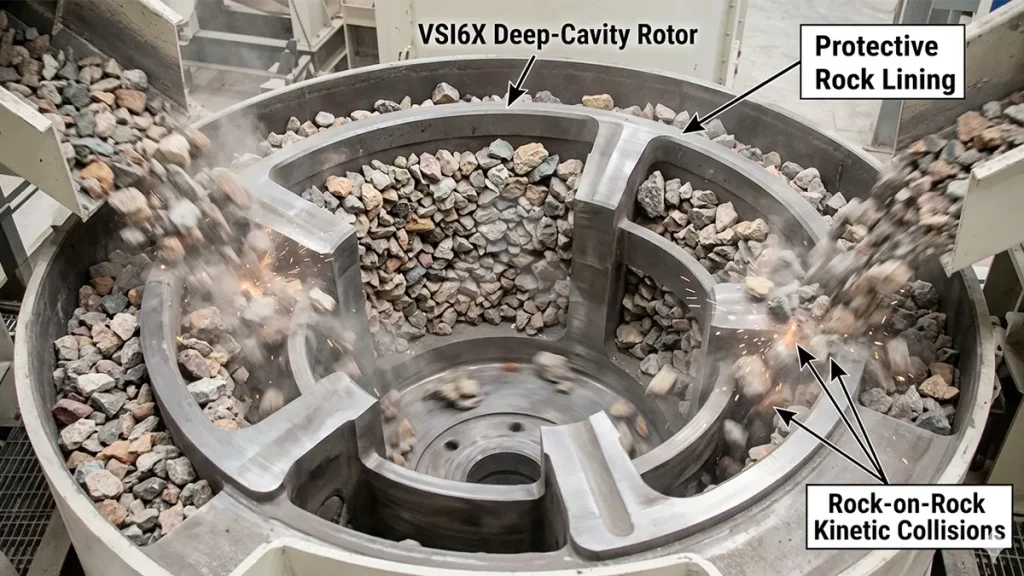
To correct the grain architecture and salvage the production-to-yield ratio, the circuit must integrate a VSI6X1040 acting as a tertiary shaper. The VSI does not rely on steel anvils. It forces the pebbles into a “rock-on-rock” kinetic collision within its deep-cavity rotor. The stones are accelerated to extreme velocities and violently smashed into a stationary rock bed lining the crushing chamber. This kinetic friction physically shears off the sharp, flaky edges, reducing the final flakiness index to a strict <8% and producing perfectly cubical aggregate.
A strict 3-stage hierarchy is required to balance abrasive survival with geometric compliance.
| Process Stage | Recommended Model | Capacity (tons per hour) | Kinetic Function |
|---|---|---|---|
| Primary Extraction Gatekeeper | C6X125 Jaw | 230-760 | Gross Compressive Reduction |
| Secondary Abrasive Survival | HPT300 Cone | 110-440 | Lamination Crushing (Flaky Output) |
| Tertiary Geometric Shaping | VSI6X1040 | 264-515 | Rock-on-Rock Kinetic Collision |
Examine the 400kW power draw of the VSI6X1040 (running dual 200kW motors). This massive electrical investment is not for size reduction; it is strictly dedicated to generating the rotational velocity necessary to execute high-speed rock-on-rock shaping, curing the flakiness index created by the cone.
Closed-Circuit Screening and Zero-Waste Mass Flow
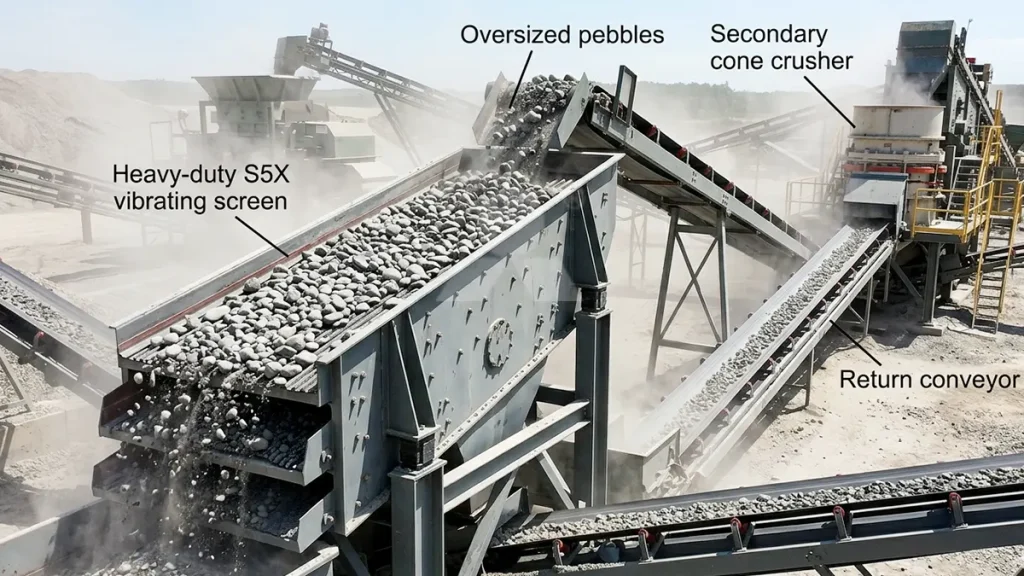
An open-circuit pebble plant guarantees a mass balance deficit. You cannot simply push rock through three machines and hope it reaches the correct specification. The layout must mandate a tightly integrated closed-circuit screening matrix utilizing heavy-duty S5X vibrating screens.
Field Note: I shut down a poorly designed river pebble operation in Southeast Asia where the designer omitted the return conveyor. The +20mm oversize material bypassed the cone and ended up directly in the final product pile, resulting in the rejection of 1,500 tons of aggregate by the local highway authority.
In a properly architected closed circuit, the material exiting the HPT cone hits the S5X screen. Any uncrushed +20mm pebbles that fail to pass the mesh are captured and continuously recirculated back to the secondary cone’s feed hopper. This geometric loop forces the rock to undergo repeated lamination crushing until it submits to the required parameters, ensuring a strict zero-waste extraction flow.
85% Silica Pebble Circuit: Kinetic Load Integration
- Sustained Node Flow: 280-310 tph continuous extraction
- Tertiary Drive Power: 400 kW (Dual 200kW VSI6X1040 motors)
- CSS Calibration: HPT300 cone strictly locked at 18mm
- Screening Matrix: Closed-circuit S5X with +20mm absolute return loop
- Grain Yield Verification: <8% flakiness index post-VSI shaping
LH-RIVER_PEBBLE_STONE_CRUSHING_PLANT-June/2026-Ref-#82914
Enforcing the 3-Stage Architectural Mandate
Designing a river pebble circuit based on generic aggregate blueprints is deliberate fiscal sabotage. High-silica rock demands a rigid 3-stage hierarchy. Forcing an impact crusher into the secondary position will trigger a catastrophic wear-part hemorrhage. Bypassing the VSI6X shaping stage will guarantee a 20% flakiness index, rendering your final product commercially worthless. If you do not lock your mass flow into a closed-circuit loop with absolute S5X screening compliance next month, your entire circuit amortization cycle will collapse under the weight of rejected inventory and destroyed steel.
Mandate the VSI integration and secure your grain geometry immediately.

